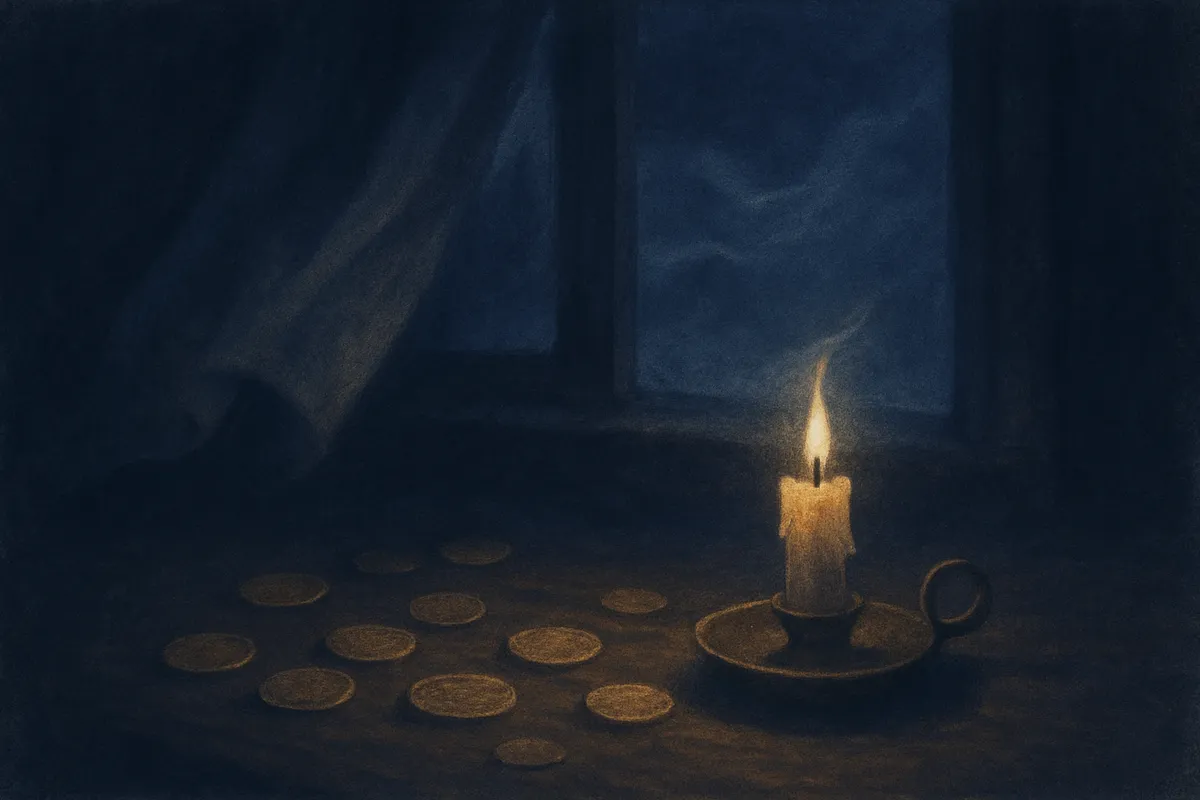
Most people who dream of money wake up hoping it was a sign of fortune. Here is the strange, consistent truth: almost no tradition read it that way. From the European folk books to the Polish sennik to the classical Islamic interpreters, dream-money is treated with suspicion — a symbol to be examined, not celebrated. That skepticism turns out to be more interesting than any fortune omen.
What the traditions say
The old European folk books distinguished coin from paper. Small coins meant small vexations and petty disputes; found money warned as much as it promised — windfalls in dreams were suspect; and counting money read as anxious accounts, in every sense. Only giving money away read brightly: relief from a burden.
The Polish sennik canon is famously terse, and its money entry is famously wary: "found money — beware a loss elsewhere." Counting money, worries about the household purse; small coins, small quarrels; giving money, relief. Paper money fares a little better in the sennik — an opportunity, if handled soberly — but the windfall suspicion runs through the whole entry.
The tabir tradition attributed to Ibn Sirin has the most distinctive reading of all: coins often meant words — disputes, speech, accounts between people — while lawful sustenance appeared instead as clean silver or provision. Even then, the reading was graded by the coins' state: bright and whole, beneficial dealings; bent or false coin, deceitful talk.
Note what money is not, in these books: it is not gold. The folk tradition could read found gold as fortune and a season of plenty, where found money drew a warning — and classical tabir read gold with its own counter-intuitive caution. The two symbols sit on different pages for a reason, and dreamers who conflate them miss what each tradition was actually saying.
What psychologists notice
Psychologists read dream-money as self-worth and resource in the broad sense — energy, time, standing, what you have to spend — rather than literal cash. Finding money often tracks with discovering a capability; losing it, with fear of depletion or of being undervalued; counting it, with waking seasons of anxious reckoning.
Which puts the psychological register in quiet agreement with the old books: both hear a dreamer doing arithmetic about worth. The dream isn't forecasting your finances — it's showing you the ledger you've been keeping without noticing.
A question to sit with
If the money in your dream stood for something you spend besides money — time, attention, standing — what have you been anxiously counting lately?
If you found money
The variant every searcher hopes about, and the one the traditions doubted most. The folk books read found money as a warning wearing a promise's clothes; the sennik says it outright: beware a loss elsewhere. Psychologists offer the kinder possibility — a resource or capability you didn't know you had, just surfacing. The mood of the dream usually decides it: uneasy luck feels different from real relief, even asleep.
If you were counting it
The traditions converge here. The folk books: anxious accounts, in every sense. The sennik: worries about the household purse. Psychologists: counting dreams tend to arrive in seasons of anxious reckoning — money, yes, but also days, chances, and what one is owed. If you dreamed of counting, the useful question is what tally you've been running by day.
If you gave it away
The one reliably bright variant. Both the folk books and the sennik read giving money away as relief — a burden set down, an account closed. The psychological ear hears the same: releasing something you'd been holding at cost. If the giving felt light in the dream, that lightness is the reading.
If it was coins
The most distinctive reading belongs to the tabir tradition: coins as words — speech, disputes, accounts between people — with their condition grading the reading, bright coins toward beneficial dealings and bent or false coin toward deceitful talk. The Western folk books arrive nearby from another direction, reading small coins as petty quarrels and vexations. If your dream-money jingled rather than folded, the old interpreters would have asked about your conversations, not your bank balance.
A dictionary can tell you that the traditions distrusted found money. It can't see that yours turned up in your childhood kitchen, or that you dream of counting coins every time a decision at work drags on — and whether dreams carry any message at all is a question worth asking honestly. Seeing your own patterns takes your own dreams, remembered together, and that's exactly what Dreamlock — coming soon to iPhone — is built to do.