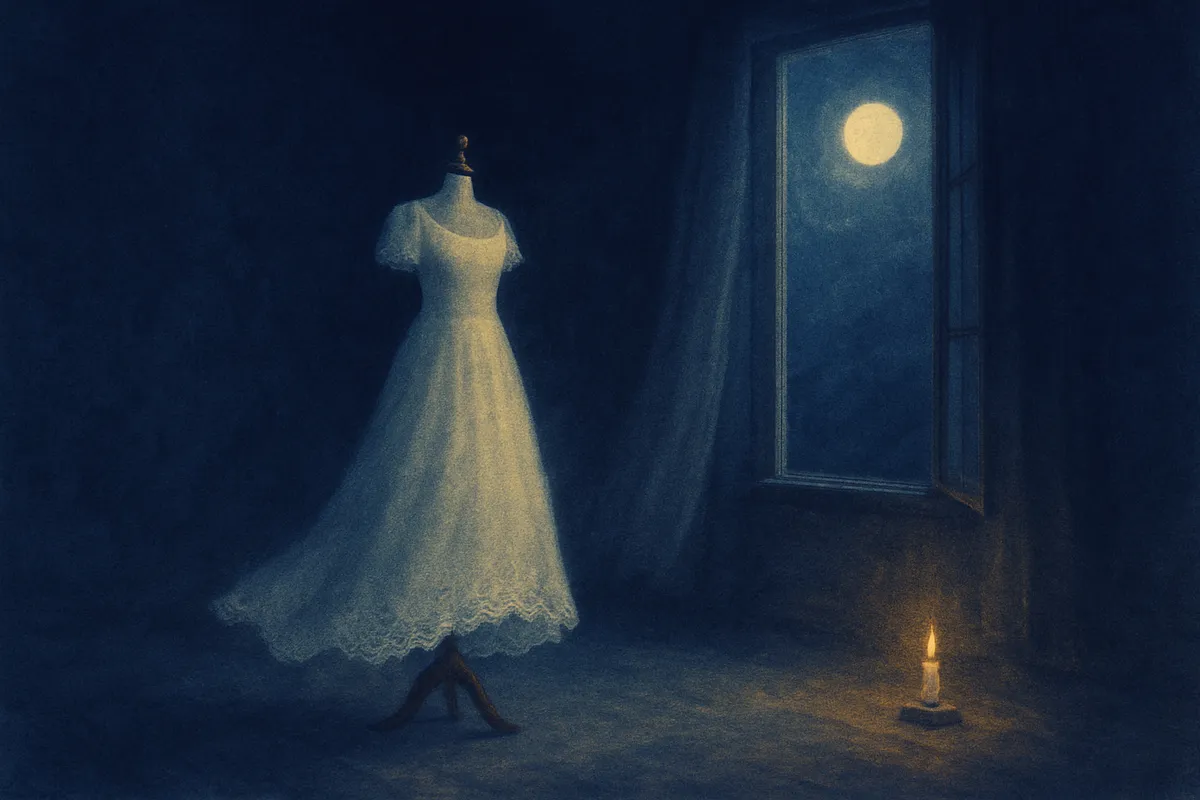
The dress arrives alone more often than you'd think: on a stand, in a mirror, folded in a box in the wrong house, with no wedding attached anywhere in the dream. That solitude is the tell. A wedding dream is about a binding; a wedding dress dream is about the person expected to wear it.
| Variant | What the old book read | Source |
|---|---|---|
| Wearing a wedding dress | An inheritance, if dressing pleased; disappointment if not | Miller 1901 |
| A torn or stained dress | Losing close relations with someone admired | Miller 1901 |
| A bridal veil | A successful change and much happiness | Miller 1901 |
What does it mean to dream about a wedding dress?
Of the three old books cited on this site, only Miller's 1901 dream dictionary (Ten Thousand Dreams Interpreted) reads the dress, and he read it kindly. Under "Wedding Clothes" he read seeing them as taking part in pleasing work and meeting new friends; a second line turns the entry: clothes soiled or in disorder meant losing close relations with someone much admired. Under "Bride" he read a young woman dreaming of her bridal dressing by her own mood, pleased or displeased, and under "Veil" a successful change.
That is a narrower shelf than people expect. The Golden Wheel Dream-Book (1862) has marriage and weddings but no dress, and Artemidorus discusses white garments only as everyday clothing. Colour meanings found online, the black dress or the red one, are modern additions.
What Miller's readings share is a method worth keeping: he read the dress by its condition and by how the dreamer felt wearing it, not by the wedding. The modern reading does the same.
Wearing or looking for the dress
These are readings from the old dream books, reported as history — no dream foretells the future.
What does it mean to dream of wearing a wedding dress?
You stand in the dress, and someone is fastening the back. Miller's 1901 dream dictionary read a young woman dreaming she was a bride as an inheritance that would please her greatly, if she was pleased while dressing, and as disappointment in what she had looked forward to if she was not. Psychologists hear a role being tried on: a commitment taking shape, and you inside it.
Was your dream different? Dreamlock reads the one you actually had →
What does it mean to dream you can't find your wedding dress?
The ceremony is starting, and the dress is nowhere: not in the wardrobe, not in the box. Miller doesn't read a lost dress, and neither book beside him has the dress at all. Psychologists hear hesitation that hasn't found words yet, or anxiety about how a step will look and who will approve. Is your unease about the commitment itself, or about being seen making it?
Was your dream different? Dreamlock reads the one you actually had →
The state of the dress
What does it mean to dream of a torn or stained wedding dress?
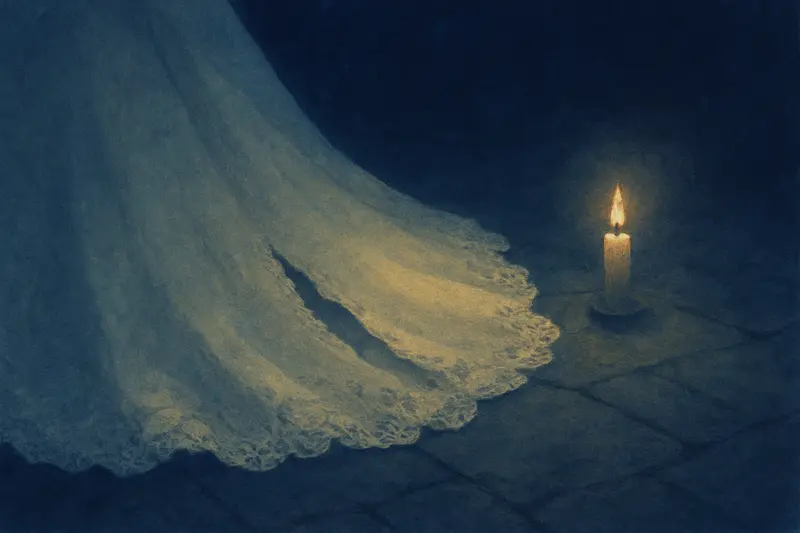
A tear in the lace, a mark down the front that won't come out. Miller's 1901 dream dictionary read wedding clothes seen soiled or in disorder as losing close relations with someone much admired, the one dark line in a kind entry. The gentler modern reading: some part of you has noticed a gap between a commitment as promised and as it actually is, and put the evidence where you'd have to look at it.
Was your dream different? Dreamlock reads the one you actually had →
What does it mean to dream of a bridal veil?
A veil lowered over the face, or lifting in a draught. Miller's 1901 dream dictionary read seeing a bridal veil as a successful change soon and much happiness in one's position; if the veil came loose or met with an accident, he read sadness and pain. Psychologists hear the moment just before being seen: something about to be revealed, or kept back a little longer.
What does a wedding-dress dream mean psychologically?
Psychologists hear the wedding dress as the full weight of expectation: the garment of how you are supposed to appear at a defining moment. Many dreamers find it arrives when they are examining what they have agreed to: an engagement, yes, but just as often a job, a move, a role in the family that everyone has quietly assumed is yours.
The body of the dream is usually the fit. A dress that fits tends to accompany acceptance. One that doesn't fit, or can't be found when the moment comes, tends to accompany a quiet hesitation. The dream is rarely asking whether you love someone. It's asking whether the role fits the person being fitted.
A question to sit with
What role are you currently being measured for, and when you imagine wearing it in front of everyone, does it fit?
Miller wrote about wedding clothes, not about the one you wore. Maybe it was your mother's dress, or it appears every time a decision at work starts to feel permanent. Only a record of your own nights can show that. Dreamlock, on the App Store for iPhone, keeps that record: it listens to the dream you record, paints it, and remembers when the dress comes back.