
A car crash dream ends the way the real thing does: all at once. One moment the dream has ordinary motion in it, the next there's impact, and you're awake with your heart going. Two things are worth knowing while it settles: the old dream books we cite have no car crash in them, and no dream is a preview of an actual one.
The nearest Miller and the Golden Wheel come are general entries, analogues rather than car crashes:
| Analogue in the old books | What it read | Source |
|---|---|---|
| A collision (no vehicle named) | An accident of a serious kind, disappointment in business | Miller 1901 |
| An accident to you or your household | By contraries: meeting someone unexpected | Golden Wheel 1862 |
| Being thrown from a vehicle | Hasty and unpleasant news | Miller 1901 |
What does it mean to dream about a car crash?
Miller's 1901 dream dictionary (Ten Thousand Dreams Interpreted) has no car crash, but his "Collision" entry, which never names the vehicle, read a dream of a collision as a serious accident and disappointments in business, and his "Accident" entry told the dreamer to avoid travel for a short while. The Golden Wheel Dream-Book (1862) read the same kind of scene by contraries and without alarm: an accident to the dreamer or anyone in the household meant only meeting someone little expected.
So the two books disagreed about accidents long before the car crash became a common dream. Everything else on this page is the modern reading. Psychologists read crash dreams by role: who was driving, who was watching, and how it ended. The crash itself is usually the least specific part.
Your part in the crash
These are readings from the old dream books, reported as history — no dream foretells the future.
What if you were behind the wheel?
The variant that asks the most of you, because the dream hands you the wheel. Psychologists read it as a question about pace and choices: a decision accelerating faster than you can steer, or a sense that your own momentum is the danger. None of this is blame. A driver is also the one person who can slow down.
Was your dream different? Dreamlock reads the one you actually had →
What if you only witnessed the crash?
Watching from the kerb or the passenger seat gives the dream a different weight. These dreams tend to visit people who are watching someone, a friend, a sibling, a colleague, take a direction they can't endorse and haven't found a way to mention. The dream registers the watching. What you do with it in daylight is yours to weigh.
Was your dream different? Dreamlock reads the one you actually had →
What happened to you
What if you were thrown from the car?
Being thrown clear is the most violent version, and the most helpless. Miller's general "Vehicle" entry, which covers any conveyance, read being thrown from one as hasty and unpleasant news, and a broken vehicle as failure in important affairs. Psychologists hear a sudden loss of control: a role, a plan or a relationship you were inside one day and outside the next.
What if you walked away from the crash?
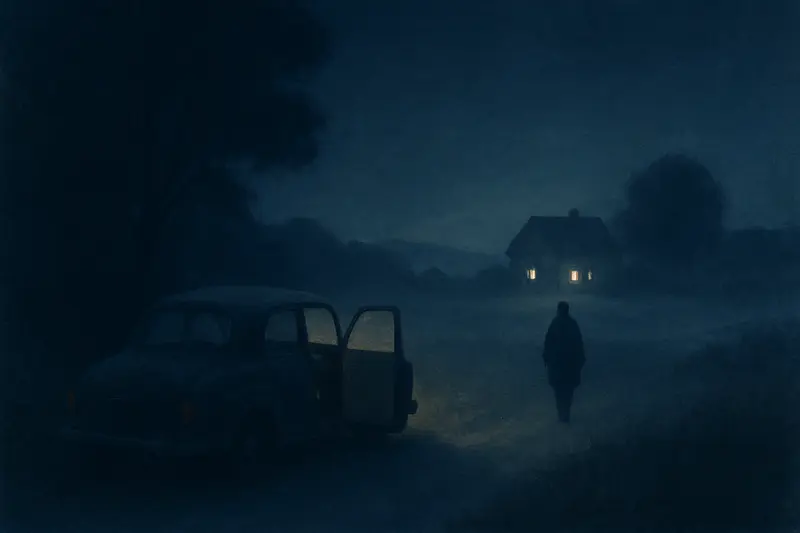
Dreamers often fixate on the impact and forget they were standing at the end. The last frame is part of the dream. Psychologists read walking away as resilience after disruption: something collided, it cost something, and the dreamer is still upright. If the dream ended with you checking yourself for injuries and finding none, that detail is worth keeping.
Was your dream different? Dreamlock reads the one you actually had →
What does a car crash dream mean psychologically?
Psychologists hear crash dreams as momentum gone wrong: something under way that has collided with something else. They turn up at recognisable moments: when a plan meets a fact it hadn't accounted for, when a relationship hits what it had been steering around, when an assumption carrying real weight fails. The car makes a fitting image because it is how many people carry their plans, their commute and their independence.
One detail of the dream's construction is telling. It rehearses the collision, not the recovery: it replays the impact and rarely shows the tow truck. That is the invitation, to look, awake, at what was driving and what it struck.
A question to sit with
Where in your life is something moving fast right now, and what, honestly, is it on course to meet?
Every reading above turns on details no dictionary can reach: whose hands were on the wheel, who was in the car, whether this dream came once or comes every time work speeds up. Those specifics, and the pattern they make over months, are what Dreamlock, on the App Store for iPhone, is built to hold: it listens to the dream you record, paints it, and remembers every road it comes back to.