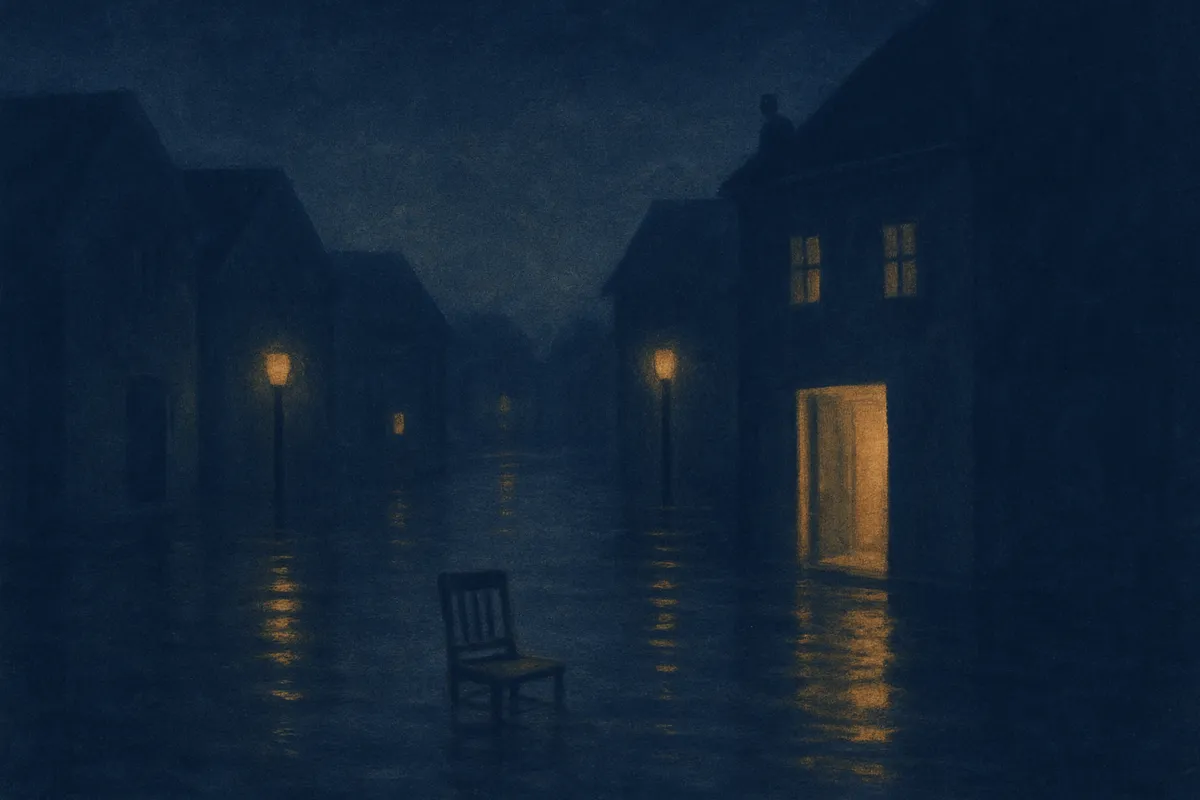
A flood dream is not really a water dream. Water is read by its condition, clear or murky, deep or still, but a flood is water in the wrong place: the street become a river, the stairs become a shore. Miller and the Golden Wheel gave it entries of its own, and split over what it meant.
| Variant | What the old books read | Source |
|---|---|---|
| Being swept away | Loss in business, an unsettled marriage; loss and danger | Miller 1901; Artemidorus |
| A flood in your house | Wealth; or, with muddy water, an enemy's harm | Golden Wheel 1862; Artemidorus |
| Clear floodwater | Profit and ease after hopeless struggles | Miller 1901 |
What does it mean to dream about a flood?
The Golden Wheel Dream-Book (1862) read the flood against expectation: "To dream of a flood, generally denotes riches and plenty, particularly if the water is calm," and even a loss, it said, would be balanced by good fortune elsewhere.
Miller's 1901 dream dictionary (Ten Thousand Dreams Interpreted) read almost the opposite. Cities or countryside sunk under "dark, seething waters" he read as great misfortune through some dreadful calamity; only land flooded with clear water turned his reading bright. Artemidorus, whose Oneirocritica (2nd century) we cite in Friedrich Krauss's 1881 German translation, has no flood entry, but in his passage on rivers he read water by its clarity too: clear water entering the house as a rich visitor, muddy water as an enemy.
What the books share is an eye for the water itself: calm or seething, clear or muddy.
What the water did
These are readings from the old dream books, reported as history — no dream foretells the future.
What does it mean to dream of being swept away by a flood?
No footing, just current. Miller read floods carrying the dreamer along with their muddy debris as sickness, loss in business and an unsettled marriage, and Artemidorus read a river sweeping the dreamer away as still greater loss and danger. These are old verdicts, not forecasts. The modern reading is a situation that outgrew its banks; notice what you reached for, and whether anything held.
Was your dream different? Dreamlock reads the one you actually had →
What does it mean to dream of a flood in your house?

Water in the hallway brings the flood home. The Golden Wheel Dream-Book (1862) read a stream overflowing its banks and surrounding the house as "a sign of wealth", more water meaning more. Artemidorus split the scene by colour: a muddy stream pouring in meant an enemy harming the household, a clear one a rich visitor. Psychologists hear private life overwhelmed: family, home, the self.
Was your dream different? Dreamlock reads the one you actually had →
How you came through
What does it mean to dream you reached higher ground?
Waking on the roof, or at the top of a hill, the water below: the brightest outcome. The three books read the flood and the water, never the climb. The modern reading is refuge found by your own action. The useful question isn't why the water came; it's what, in the dream, you climbed.
Was your dream different? Dreamlock reads the one you actually had →
What does it mean to dream the floodwater was receding?
The quiet ending: a tideline on the wall, ground reappearing. None of the three reads receding water. Psychologists read it gently: some part of you has registered that the worst of a season is behind you, before you've said so out loud. A flood also leaves a changed landscape, silt but also cleared ground.
What the water looked like
What does it mean to dream of clear floodwater?
Clear water is the surprise version: flooding, yet you can see the bottom. Miller turned his whole inundation entry around here: "To see a large area inundated with clear water, denotes profit and ease after seemingly hopeless struggles with fortune." Psychologists hear an overwhelming feeling that is at least understood: too much, but not murky.
What does it mean to dream of muddy floodwater?
Brown water hides what's in it. None of the three books has a line for muddy floodwater as such; the nearest are Miller's "muddy debris" and Artemidorus's muddy stream in the house, both read darkly. Psychologists hear confusion: a situation you can't see into, where the danger is not knowing what's under the surface.
What does a flood dream mean psychologically?
Psychologists tend to place flood dreams at moments of significant life change, when emotion, demand or circumstance has risen beyond what the ordinary structures can contain. The dream is less alarm than acknowledgment: some part of you has already noticed the water line. They also refuse to read the flood as purely destructive. Floods recede, and some of what the water takes, the dreamer had been carrying too long.
A question to sit with
If the flood in your dream had a name (a person, a job, a season of your life), what would it be, and where is your higher ground?
Riches to the Golden Wheel, calamity to Miller: the books settle nothing about your flood. What might is the pattern, such as water that always starts at your office door, or rises only before you have to say no to someone. That pattern lives in your own dreams, remembered together. It's what Dreamlock, on the App Store for iPhone, is built for: it listens, paints each dream, and remembers where the water rose.