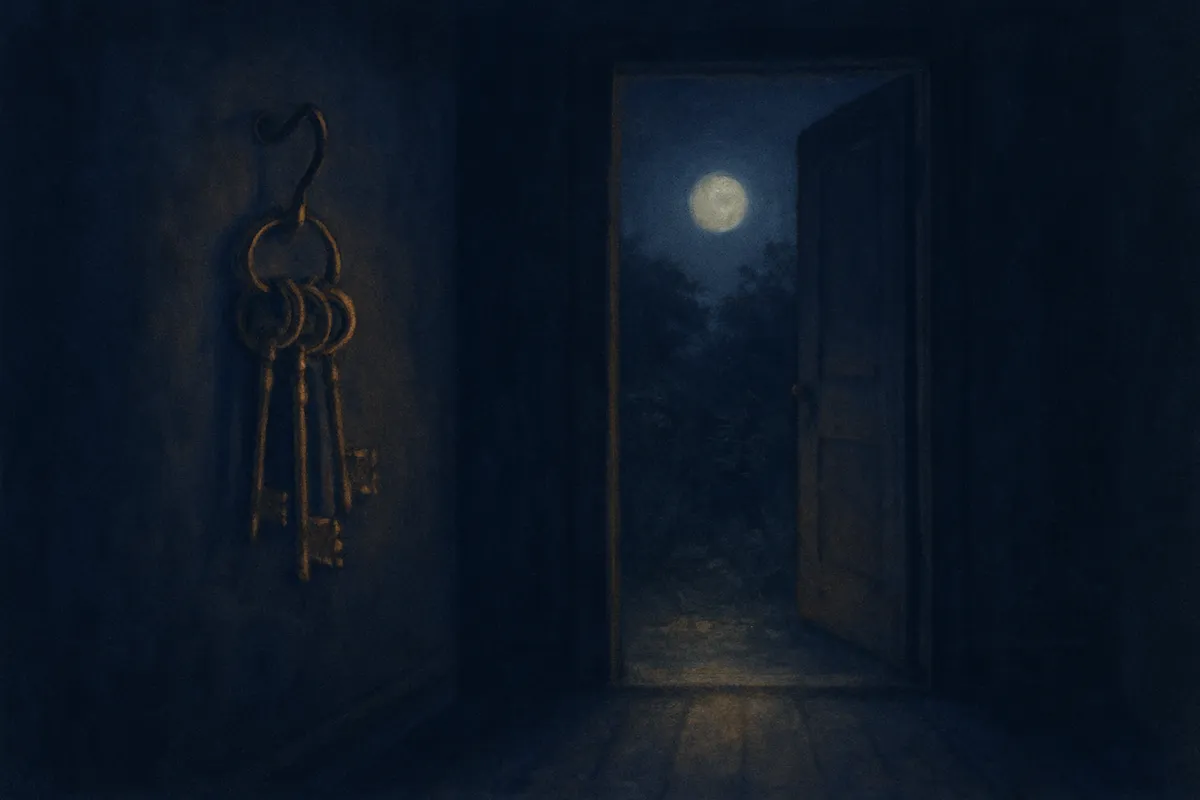
Keys are small in the hand and enormous in dreams. A dreamer who loses a kingdom sleeps on; a dreamer who loses their keys wakes up patting the sheets. A key is never about the metal. It's about the door, and about who gets to pass through it.
| Variant | What the old books read | Source |
|---|---|---|
| Losing your keys | Unpleasant adventures; coming to shame | Miller 1901; Golden Wheel 1862 |
| Finding a key | Domestic peace; a secret told | Miller 1901; Golden Wheel 1862 |
| A broken key | Separation | Miller 1901 |
| Giving your key away | Poor judgement in conversation | Miller 1901 |
| Unlocking a door | A new lover, trusted too much | Miller 1901 |
| Locking a door | Success in choosing a husband | Miller 1901 |
| A keyhole | A confidence betrayed; false friends prying | Miller 1901 |
What does it mean to dream about keys?
Miller's 1901 dream dictionary (Ten Thousand Dreams Interpreted) opened its "Key" entry neutrally: "To dream of keys, denotes unexpected changes." Whether those changes were good or bad depended on what happened to the keys: found, lost, broken or given away. Much of the entry is addressed to a young woman, and reads keys as courtship and reputation. The Golden Wheel Dream-Book (1862) kept a short entry built on loss and discovery.
Artemidorus, whose Oneirocritica (2nd century) we cite in Friedrich Krauss's 1881 translation, read the key by the dreamer's plans. To someone hoping to marry it promised a faithful, home-loving wife; to someone managing others' affairs, a sign of trust. But he noticed something the others didn't: a key, he wrote, is made not for opening doors but for locking them. So for a traveller he read a key as an obstacle. The books agree that keys mean access; they disagree about which way the door swings.
Losing and finding keys
These are readings from the old dream books, reported as history — no dream foretells the future.
What does it mean to dream of losing your keys?

The pockets are empty, the door is shut, and the panic is completely real. Miller read lost keys as unpleasant adventures. The Golden Wheel Dream-Book (1862) was harsher, calling it "a bad omen" of coming to shame. Artemidorus recorded a traveller who dreamed he had lost his house key and came home to find his household had come to harm: the dream, he explained, had said that things at home were not safe. Psychologists hear the feeling of being shut out of a life that was yours an hour ago.
Was your dream different? Dreamlock reads the one you actually had →
What does it mean to dream of finding a key?
A found key tends to feel like relief with a question attached: what does it open? Miller read finding keys as domestic peace and brisk turns in business, the plainly happy branch of his entry. The Golden Wheel Dream-Book read finding a key as a sign that someone would tell the dreamer a secret. The modern reading is access newly in reach: a solution, a permission, a way in.
What does it mean to dream of a broken key?
A key that snaps in the lock is a peculiar frustration: the door is there, the means fail. Miller gave it the gravest line of his entry, reading broken keys as separation, "either through death or jealousy". That is an old fear, not a forecast. The modern reading is gentler and more practical: the method is failing, not the door. If you've pushed at something the same way for months, this may be the dream's point.
Was your dream different? Dreamlock reads the one you actually had →
Keys that change hands
What does it mean to dream of someone giving you a key?
Being handed a key is an intimate gesture, and the giver is usually vivid. The three books read keys found, lost and given away, but not a key received. The modern reading is trust extended, and often responsibility with it. A key from a stranger, a parent or someone long gone are three different dreams, and what you felt on taking it is the reading.
Was your dream different? Dreamlock reads the one you actually had →
What does it mean to dream of giving someone your key?
Handing over your own key can feel generous or reckless. Miller read a young woman giving her key away as failing to use judgement in conversation and darkening her own reputation. Psychologists hear a boundary opened, and ask whether it was chosen or conceded.
Locks and doors
What does it mean to dream of unlocking a door with a key?
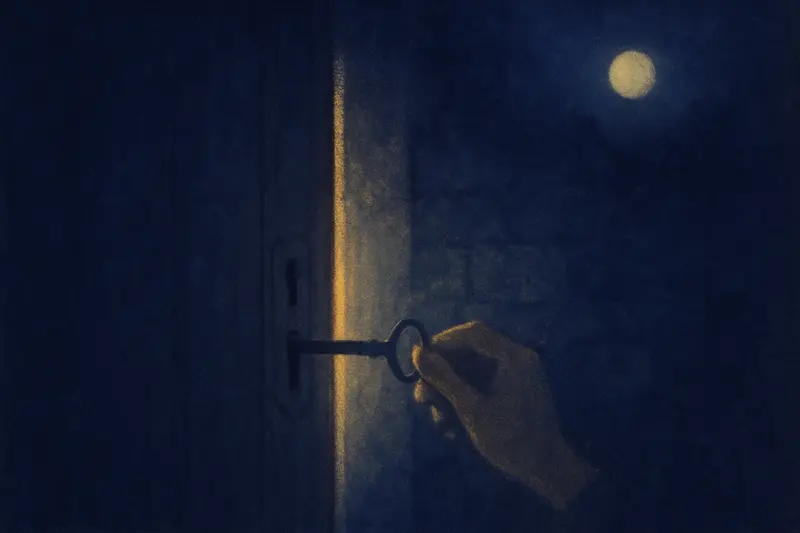
The key turns, and the door gives. Miller read a young woman unlocking a door as a new lover in whom she would place too much confidence; his "Lock" entry read a lock that yields as discovering who is working against one. The modern reading is permission: something that was closed is open now.
What does it mean to dream of locking a door?
Locking up is a dream of safety, or of shutting something out. Miller read a young woman locking a door as success in choosing a husband, while a lock that resisted meant scorn in love. Psychologists ask what you were keeping in, or out.
What does it mean to dream of looking through a keyhole?
The keyhole makes the dreamer a spy, or the one spied on. Miller read peeping through one as betraying a confidence, others peeping as false friends prying, and not finding a keyhole as unconsciously injuring a friend. The modern reading is curiosity, and unease about what you aren't told.
What does a key dream mean psychologically?
Psychologists hear keys as the feeling of access: dreamers tend to meet them when a solution or a permission is close but not yet grasped. Losing keys tends to accompany the sense of being shut out; finding or receiving one tends to arrive just as something closed begins to yield. And Artemidorus's odd insight, that keys are really for locking, has a modern echo: the key dream is often about control, who keeps a door shut and who is kept out.
A question to sit with
What are you standing in front of right now, a role, a person, a version of yourself, waiting for permission to enter? And who do you imagine holds the key?
Miller read keys for a young woman's prospects; Artemidorus, for a traveller's road. Neither could know that yours never fit your own front door, or that they only go missing before you travel. Patterns like that surface only when your dreams are kept together, which is what Dreamlock, on the App Store for iPhone, is built for, and it starts with remembering them.