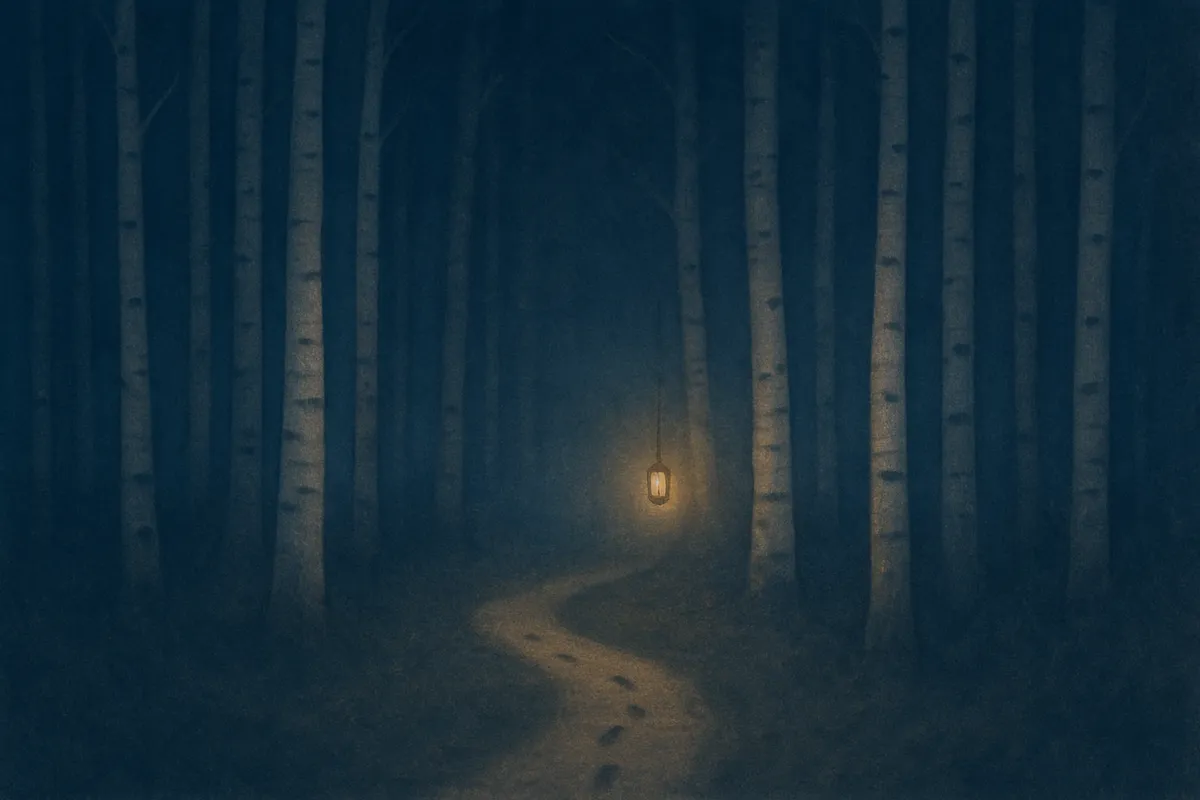
Many people know this dream from the inside: the street that should lead home doesn't, the corridor repeats, the landmarks have quietly rearranged themselves. Nothing attacks you. You are simply, completely unable to say where you are, and the feeling follows you into the first minutes of morning.
| Variant | What the old books read | Source |
|---|---|---|
| Lost in a forest | Loss in trade, quarrels at home; for lovers, being crossed | Miller 1901; Golden Wheel 1862 |
| Lost in a maze | Perplexing business; green vines turn it to happiness | Miller 1901 |
| Lost in the snow | "Constant waves of ill luck" | Miller 1901 |
| Lost on an open plain | "Sadness and ill luck" | Miller 1901 |
What does it mean to dream about being lost?
Miller's 1901 dream dictionary (Ten Thousand Dreams Interpreted) filed the dream under "Way", and read it as a warning rather than a verdict: to dream of losing one's way meant putting "lucky speculations" out of mind, because the dreamer's enterprises threatened to fail unless their affairs were handled with painstaking care. For Miller the lost dreamer was a careless manager.
He then read the dream by landscape, and the landscape changed the tone. Forest, labyrinth, snow and prairie each have their own line, and one of them, the labyrinth, even turns hopeful. The Golden Wheel Dream-Book (1862) has only a rhyme: wandering over plains, walking cross ways and lanes, and being lost in thick woods declared that "lovers shall be crost."
What neither English book reads is the feeling: calm, panic, relief. Those variants below get the modern reading only.
Where you were lost
These are readings from the old dream books, reported as history — no dream foretells the future.
What does it mean to dream of being lost in a forest?
The forest is the classic setting: trees that all look the same, a path that thins to nothing. Miller read finding oneself in a dense forest as loss in trade, unhappy influences at home and family quarrels. The Golden Wheel's rhyme put being lost in thick woods among the signs that lovers would be crossed. Psychologists hear something closer: too many options that all look alike, and no clear view above them.
Was your dream different? Dreamlock reads the one you actually had →
What does it mean to dream of being lost in a maze?

A maze is being lost on purpose, by design, which is what makes it unsettling. Miller read a labyrinth as entanglement in intricate, perplexing business conditions and an unhappy home, but a labyrinth of green vines and timbers as unexpected happiness from what had seemed a cause of despair. For a labyrinth of night or darkness he gave the darkest reading, "passing, but agonizing" trouble; even he stressed that it would pass. The modern reading is a problem with rules you can't yet see.
Was your dream different? Dreamlock reads the one you actually had →
What if you were lost in snow?

Snow erases paths, and a lost-in-snow dream is usually white, silent and cold. Miller gave the scene one line in his long "Snow" entry: "If snowbound or lost, there will be constant waves of ill luck breaking in upon you." In the same entry he read sunlight on snowy landscapes as adverse fortune conquered. Psychologists hear a season when the usual markers have been covered over, and nothing yet shows where to step.
What if you were lost on an open plain or prairie?
Being lost with nothing in the way is its own kind of strange: open ground, no walls, and still no direction. Miller read the prairie itself as ease and unobstructed progress, but being lost on one as "a sign of sadness and ill luck." The contrast is the interesting part. Psychologists hear freedom that has no shape yet: all the room in the world, and no reason to choose one way over another.
How it felt and how it ended
What if you were separated from someone you were with?
You were with a friend, a partner or a child, and then the crowd closed and they were gone. Neither Miller nor the Golden Wheel reads this scene. Psychologists hear it as a relationship dream as much as a direction dream: worry that someone is moving on without you, or that you are the one drifting. Who it was, and who let go, is usually the point.
What if you stayed lost but stayed calm?
Some dreamers wander for the whole dream without fear. Miller and the Golden Wheel have no reading for calm lostness; their lost dreamers are all in trouble. The modern reading is kind: some part of you is more at peace with an open question than your daytime self admits, and may be quietly curious where the unmarked road goes.
What if panic set in?
The panic version is the one that wakes people, heart racing, still turning corners. Neither book distinguishes the lost dreamer's feelings. Psychologists read the rising panic as the waking uncertainty turning urgent: a decision with a deadline, a direction that has to be chosen soon. If dreams like this regularly leave you distressed, that's worth mentioning to someone you trust.
What if you found your way in the end, or never did?
Some lost dreams resolve with a recognised street; others end still searching. Miller read the losing, never the finding. Psychologists pay attention to how the dream turned: a landmark remembered, a stranger pointing, a door that opened. Dreamers often find that the waking version of that turn is already within reach and hasn't been trusted yet. A dream that never resolves usually belongs to a question that hasn't, either.
Was your dream different? Dreamlock reads the one you actually had →
What does a dream about being lost mean psychologically?
Psychologists place this dream at transitions. It tends to arrive when the familiar markers of direction (purpose, role, belonging) have genuinely become unclear: an ending job, a finished chapter, a role that used to say who you were and has stopped saying it. The old path has closed and the new one has not yet shown itself, and the dream stages that interval.
The honest part of the reading is what the dream doesn't do. It rarely provides the map. What it confirms is that the disorientation is real, and that what you feel about your direction by day is worth taking seriously rather than talking yourself out of.
A question to sit with
Which of your usual landmarks (a role, a plan, a person you steer by) has recently stopped being where you expected it?
Miller gives you a forest or a maze. Your dream gives you a particular street, a particular panic, a particular month. Whether the lost feeling returns before decisions, after endings, or only in one town you left years ago is something only your own dreams, kept together, can show. Dreamlock, on the App Store for iPhone, listens to the dream you record, paints it, and shows you over time when the lost feeling visits.