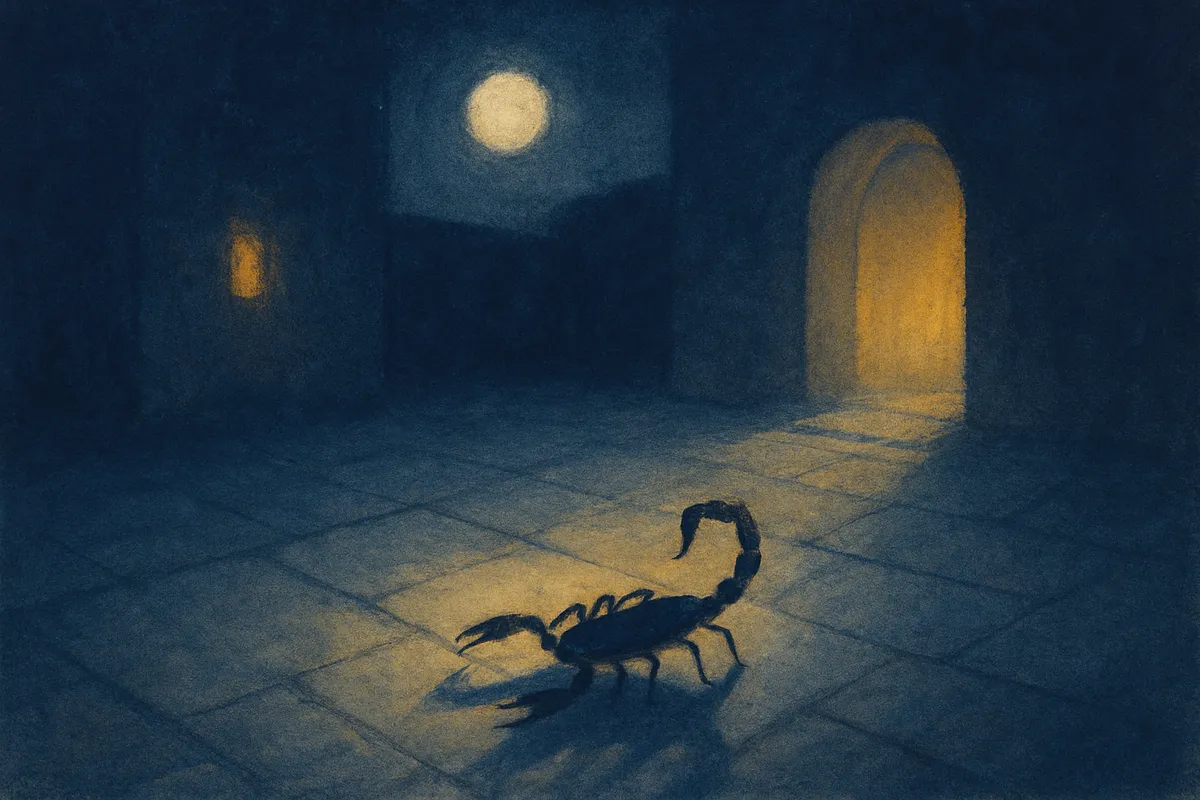
A scorpion is a small dream that leaves a long shadow. People wake from it certain it meant something — and for once, the old dream books largely agree on what. Few symbols get so consistent a reading across traditions, and few readings are as pointed.
What the traditions say
The Islamic tabir tradition has the most precise entry, and it is the one worth sitting with. The classical reading made the scorpion the backbiter — a slanderer, one who wounds with the tongue from concealment. Its sting was harm through words already moving; killing the scorpion, the slander ended; and carrying one unknowingly — the strangest and sharpest variant — an enemy given quarter in one's own affairs.
The European folk books arrive at nearly the same place: an enemy with a sting in wait, betrayal prepared quietly — harm that strikes once and from cover, often by words. The Polish sennik canon compresses it to three beats: scorpion, treachery in wait; being stung, hurt by a hidden tongue; killing one, an enemy's plan spoiled before its moment.
Where the snake divides the traditions — enemy here, healer there — the scorpion unites them. Whatever it stands for, every canon agrees it is concealed, it is precise, and it speaks.
What psychologists notice
Psychologists read the scorpion as betrayal anxiety in its most compact form: a small body built entirely around one deliverable hurt. These dreams cluster where the dreamer senses a wound being prepared for them — a conversation happening out of earshot, a warmth that has cooled without explanation.
But there is a reversal here, and it is the honest center of the symbol: psychologists note the scorpion is as often the dreamer's own defensive sting as another's. The hurt held ready, the cutting reply rehearsed, the tail curled over your own back. Either way the dream is about trust — whether you can extend it, and whether you are still safe to receive it. If the spider dreams in webs and patience, the scorpion dreams in a single sentence, saved up.
A question to sit with
Is there a sting in your life right now that is prepared but not yet delivered — and are you the one waiting for it, or the one carrying it?
If it stung you
The tabir tradition read the sting as harm through words already in motion — by the time the tail lands, the slander has been spoken somewhere. The folk books called it a wound from a hidden quarter; the sennik, hurt by a hidden tongue. The modern ear hears the anticipated injury finally making contact, if only in rehearsal: the dream letting you feel the thing you've braced for. Notice where it stung and what you did next — dreamers who tend the sting, or simply keep walking, tend to wake less shaken than the dream deserved.
If you killed it
The one variant every canon brightens on. In the tabir reading, killing the scorpion meant the slander ended; the sennik says an enemy's plan spoiled before its moment; the folk books, a threat ended before it landed. The psychological reading keeps the shape without the enemy: something concealed was dragged into the open and dealt with — which is usually how concealed things lose their sting.
If you carried it unknowingly
The tabir tradition's most distinctive entry: a scorpion carried in one's clothing or goods, unnoticed, read as an enemy given quarter in one's own affairs — harm not at the gate but already inside, tolerated, perhaps even trusted. The modern reading turns it once more: what we carry unknowingly is often our own — a resentment packed so long ago we've stopped feeling its weight. If this was your dream, the question isn't only who got in. It's also what have I been carrying as if it were harmless?
A dictionary can tell you what scorpions have meant to dreamers for a thousand years. It can't tell you why yours crossed the floor of your childhood home, or that it arrives in the weeks when you're holding your tongue. Whether any of it points at what's ahead — our honest answer is no; it points at you. Seeing that pattern takes your own dreams, remembered side by side — which is exactly what Dreamlock is built to do.