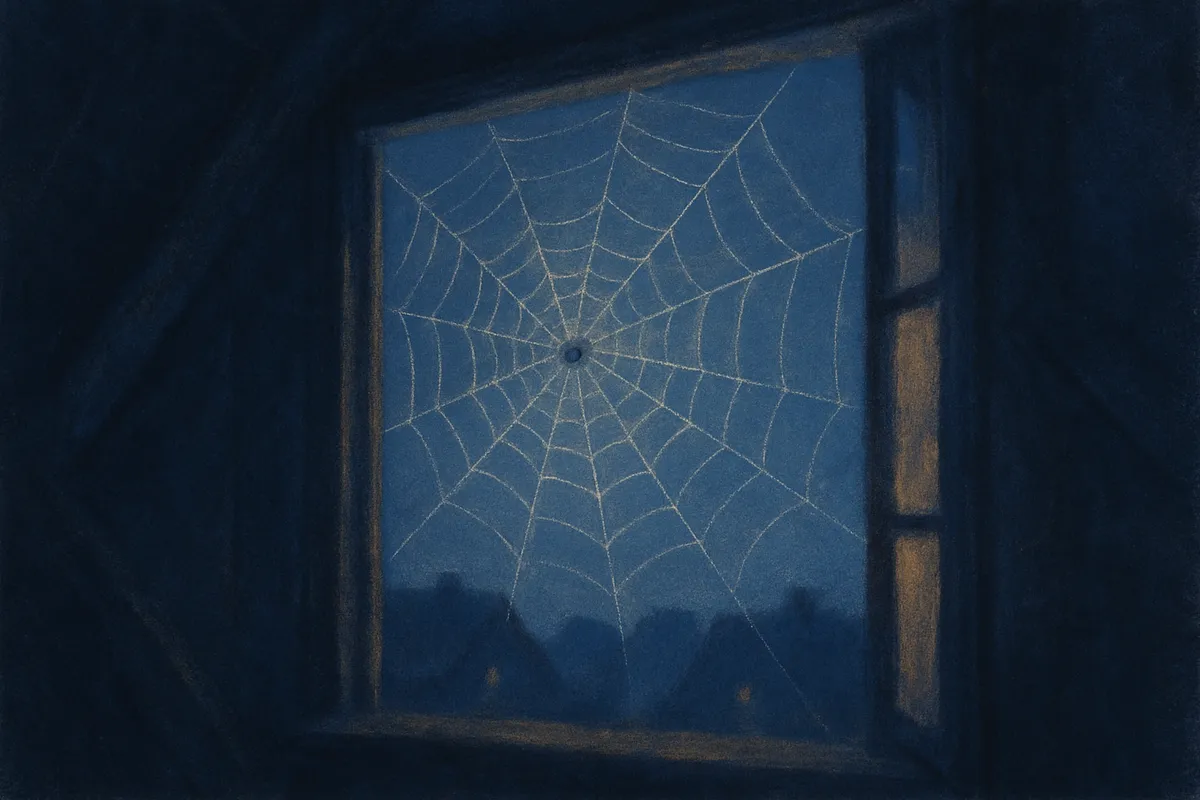
Spider dreams come with a reputation they haven't quite earned. Dreamers wake expecting the worst — and then the old dream books turn out to be surprisingly kind to the spider itself. It's the web the traditions warned about. That split, between the patient little builder and the thing it builds, is the whole key to reading this dream.
What the traditions say
The European folk books were gentler here than almost anywhere else in the dictionary. A spider at work often meant money and patient gain — the "money spider" survives in English folk belief to this day, a small industrious omen of income earned slowly. Compare that to the snake, which the same books read as an enemy on sight, or to gold, which they trusted less the easier it came. The spider earned its keep.
The web is where the folk reading darkens: webs stood for intrigue — gossip and schemes being quietly woven — and being caught in one meant entanglement in someone else's plans.
Other traditions lean harder on the scheming. The tabir tradition read the spider as a weak but scheming adversary — keeping the memory of the proverb that the spider's house is the frailest of houses — and read webs as plots that look firmer than they are. The Polish sennik canon has one of its most famous terse entries: spider — intrigue nearby; web — gossip being woven. Even there, a spider descending on its thread read lightly: unexpected news, take it calmly.
So the traditions quietly disagree about the spider — modest earner or petty schemer — but agree completely about the web. Whatever is being woven matters more than the weaver.
What psychologists notice
Psychologists call the spider an ambivalence symbol — fascination and dread in one small image. The common modern readings cluster around feeling trapped in something intricate: a situation that was woven slowly around you, thread by thread, until it held. In the Jungian line there's a second reading — entanglement with a powerful caretaking figure, care that binds as much as it holds.
Either way, the professional consensus echoes the folk one: the web usually matters more than the spider. Ask not "why a spider?" but "what in my waking life has been quietly assembling around me — and how stuck am I, really?"
A question to sit with
What in your life right now was built slowly, thread by thread, while you watched — and are you the one who was spinning it?
If the spider was at work on its web
The kindest variant in the folk tradition: the working spider was the money spider, patient gain accumulating in small increments. The modern ear hears something adjacent — something in your life is being built methodically, and the dream's mood tells you whether the building is yours. A spider you watched with calm, even admiration, reads very differently from one you watched with dread.
If you were caught in the web
Here the folk books turn stern: entanglement in someone else's plans — you've walked into an arrangement someone else wove. But the tabir tradition offers the useful corrective: the spider's house is the frailest of houses, and webs are plots that look firmer than they are. Psychologists notice the same thing from the other side — the intricate situations that feel most binding often loosen quickly once tested. What you did in the dream — struggled, went still, tore free — is worth writing down before it fades; most dream detail is gone by breakfast.
If you killed the spider
The sennik canon reads this one with a small smile: killing a spider — a small victory over malice. Note the small: not a battle won but a petty nastiness dispatched. The tabir tradition's neighboring image agrees — sweeping away a web meant a worry dissolved once confronted. If something in your waking life has felt like low-grade scheming, this is the dream of finally flicking it off the wall.
If it was many spiders
Honestly: the old books don't keep a separate entry for a multitude of spiders — the classic readings are about one spider, one web. What scales is the web logic: where one web read as an intrigue, a room full of them reads less like a single schemer and more like an environment — a workplace, a family season, a circle where too many small threads are being spun at once. Psychologists would ask which part of your life currently feels sticky in every corner.
A dictionary can tell you what spiders mean in general — even the surprising parts, like the money spider. It can't tell you why yours builds its web in your office doorway, or that it appears the same weeks your calendar fills up. That's the part only your own dreams, remembered together, can answer — and it's exactly what Dreamlock is built to do.