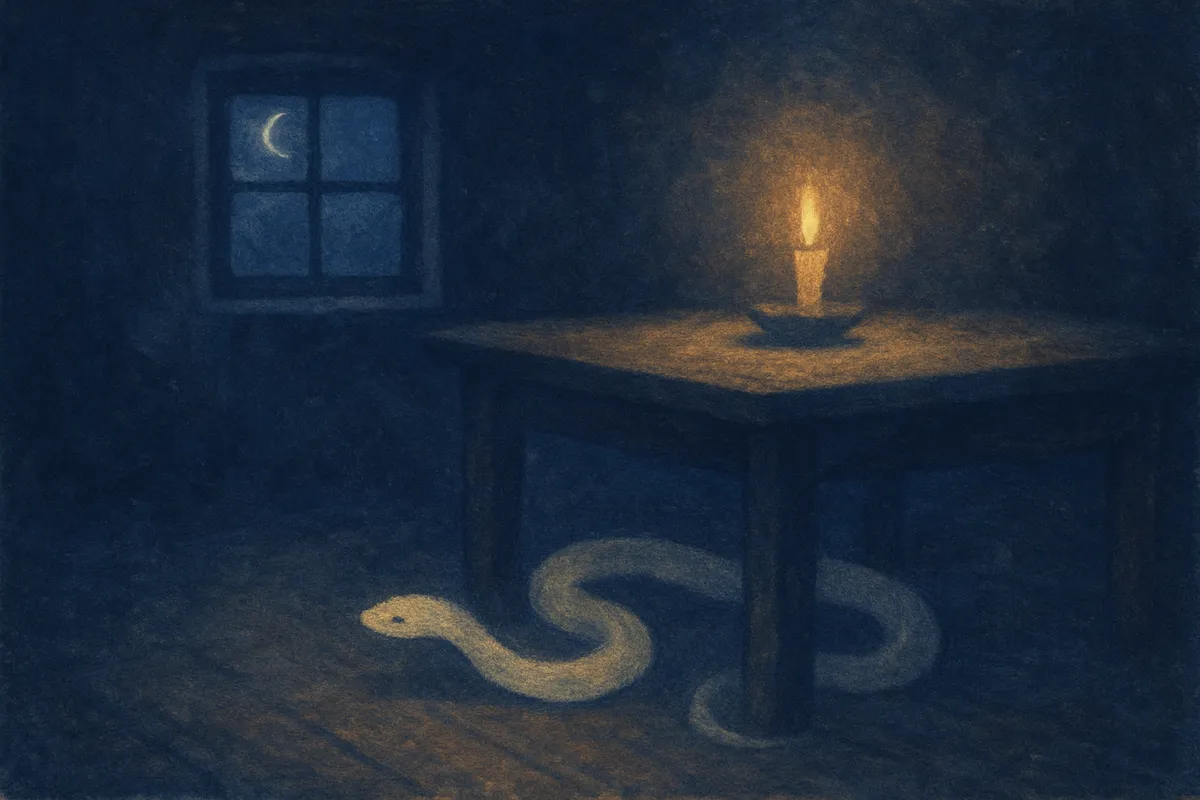
Nobody wakes from a snake dream neutral. It's the most-searched dream symbol in nearly every language, and it has been unsettling dreamers for as long as anyone has written dreams down — the oldest surviving dream manual already has an entry for it.
What the traditions say
Artemidorus, writing in the 2nd century, read the snake as sickness or an enemy — but he was careful: a snake that behaved gently could signal a powerful protector instead. The European folk books that descended from him kept that double edge. A threatening snake: a hidden enemy or a false friend. A snake shedding its skin: healing and renewal — the sign of the physician to this day. Killing the snake: the threat overcome.
Other traditions sharpen the same idea in their own directions. The Islamic tabir tradition attributed to Ibn Sirin reads the snake as an enemy and grades the reading by context — a snake in the house points inside your own circle, a snake commanded and owned can even signal authority. The Polish sennik canon is blunter still: "a false friend nearby."
Across all of them, one thing is stable: the snake is never random scenery. It stands for something specific in the dreamer's life, and the details — where it was, what it did, how you felt — are the actual message.
What psychologists notice
Freud famously pulled the snake toward desire; Jung read it as transformation — the animal that sheds its skin and comes out new. The common modern reading sits between them: a snake stands for something in waking life that feels both fascinating and unsafe. A person you can't quite trust. A change you want and fear. A truth you keep circling.
Psychologists also notice the avoidance pattern: fear of the snake in the dream often tracks with avoidance outside it. The dream isn't punishing you — it's rehearsing the confrontation you haven't had yet.
A question to sit with
What in your waking life are you currently circling — watching closely, but not touching? That's usually where your snake lives.
If the snake bit you
The bite is the variant people remember most. Folk tradition read it as a warning that arrived too late; the tabir tradition darkens the reading when venom is involved. The gentler modern reading: the avoided thing finally made contact. Note where the bite landed and what you did next in the dream — dreamers who fight back or walk away tend to describe the dream as frightening but not hopeless, and that difference is worth more than any dictionary entry.
If there were many snakes
A floor or pit of snakes shifts the reading from a person to an environment — the old books said gossip and rivalry; the modern ear hears a setting that feels hazardous in many small ways at once. Ask which room of your life felt like that this week.
If the snake shed its skin
The one unambiguously bright variant, in almost every tradition: something old coming off, something new underneath. If your life is mid-transition, this is the dream keeping pace with it.
A dictionary can tell you what snakes mean in general. It can't see that yours appeared in your grandmother's kitchen, or that it shows up every time work gets loud. That's the part only your own dreams, remembered together, can answer — and it's exactly what Dreamlock is built to do.