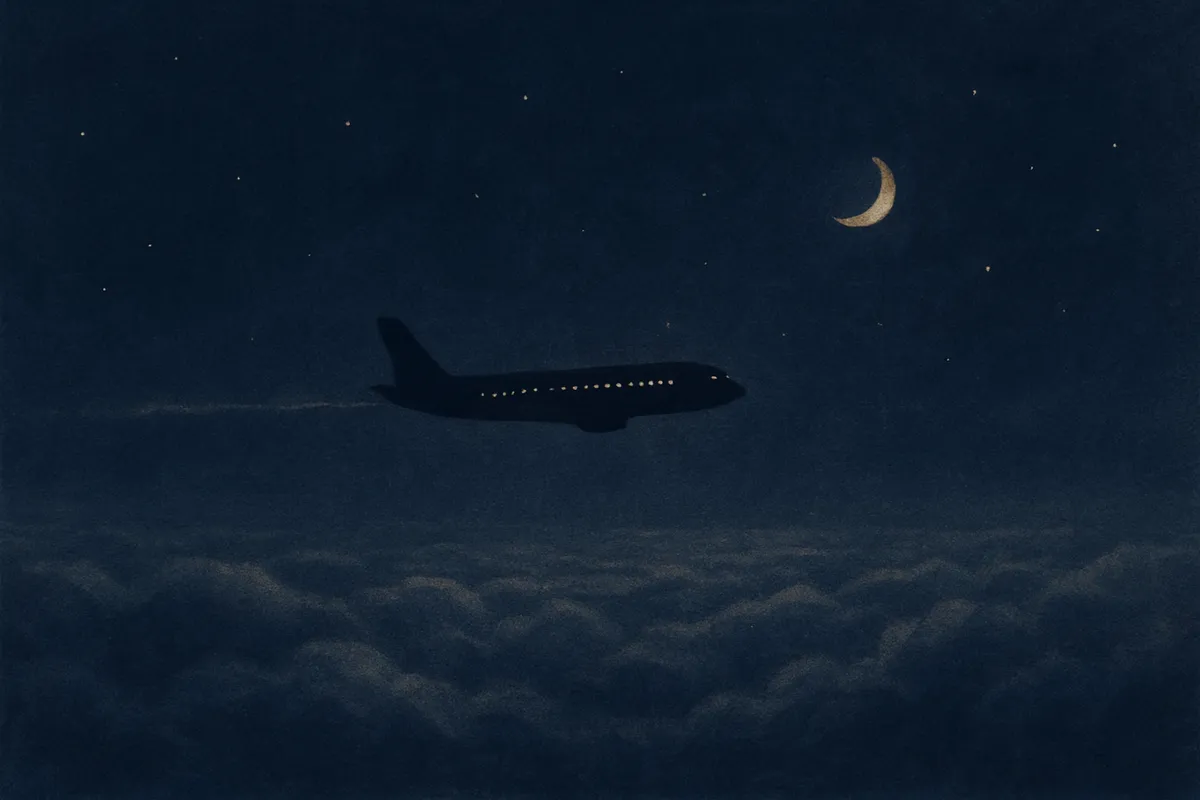
An airplane dream is a flying dream with the controls taken out of your hands. You are aloft, committed, moving fast toward somewhere, and someone you cannot see is doing the flying. That one change reorganizes the whole symbol.
The old dream books predate the scene: the nearest they come is Miller's 1901 entry for the "flying machine", which is listed below as an analogue, not as a reading of the modern airliner.
| Variant (analogue) | What the old book read | Source |
|---|---|---|
| A flying machine that would not fly | Gloomy returns for much worried planning | Miller 1901 |
| A flying machine seen in the sky | Satisfactory progress in future speculations | Miller 1901 |
What does it mean to dream about an airplane?
Miller's 1901 dream dictionary (Ten Thousand Dreams Interpreted) went to press two years before the first powered flight, yet it already had an entry for the "flying machine". Miller read it the way he read most things, by whether it worked: seen in the air, it stood for satisfactory progress in the dreamer's speculations; failing to work, for gloomy returns on a great deal of worrying and planning. The Golden Wheel Dream-Book (1862) has only a balloon, and Artemidorus, writing in the second century, knew flight only as the dreamer's own body rising.
So the crash, the turbulence and the missed flight all come after the books. The modern reading keeps Miller's instinct, though: what the machine did matters. An airplane is a commitment already made, carried by forces you don't control, and the dream shows how that feels at this stage of the journey.
When the flight goes wrong
These are readings from the old dream books, reported as history — no dream foretells the future.
What does it mean to dream of a plane crash?

The crash is the version that wakes people fastest. Psychologists see crash dreams arrive mid-commitment, when the size of what could fail suddenly turns vivid: the dream builds the failure so the fear has a shape for a night. Dreamers usually know which undertaking was on board. The ground-level cousin is the car crash, which trades ambition's altitude for daily control.
Was your dream different? Dreamlock reads the one you actually had →
What if there was turbulence?
The plane shakes, the drinks slide, and it does not go down. Turbulence dreams tend to arrive in the long middle of a commitment, after the leap and before the landing. Psychologists usually hear fear inside a change rather than doubt about the change itself: the route is still right, the ride is rough.
Was your dream different? Dreamlock reads the one you actually had →
What if the plane would not fly?
A plane that sits on the runway, engines coughing, or never leaves the gate. This is the one scene the old books reached: Miller's 1901 dream dictionary read a flying machine failing to work as gloomy returns for much disturbing and worrying planning. He described a machine that would not fly, not a crash. The modern reading runs close to his: a plan that has absorbed enormous effort and still won't lift.
What does it mean to dream of missing your flight?
The gate is closing, the boarding pass won't scan, the plane pulls away without you. Psychologists hear a large opportunity felt to be passing; felt, which is not the same as passed. This runs close to the being late dream, with a sharper sting: you knew exactly where the plane was going. Naming the destination is usually naming the ambition.
Was your dream different? Dreamlock reads the one you actually had →
When the flight goes well
What does it mean to see a plane in the sky in a dream?
You watch a plane cross overhead, small and bright. Miller's 1901 dream dictionary counted seeing a flying machine a good sign, reading it as satisfactory progress in the dreamer's future speculations. Psychologists add the distance: a plane seen from below can be an ambition admired, or one that belongs, so far, to someone else.
What if the plane landed safely?
The wheels touch, the cabin exhales. The modern reading hears a long crossing brought to earth, ideally by intention, the difference between finishing something and having it end. Which journey is closer to done than you've admitted?
What does a plane dream mean psychologically?
A modern reading calls the airplane transition at altitude. Flights tend to accompany the larger crossings (ambitions lifting off, moves, changes with no stops once begun), and the dream borrows aviation's exact emotional grammar: boarding as commitment, cruising as the long uncertain middle, landing as arrival into the changed life.
The unseen pilot matters most: trusting one is the surrender any big transition asks for. The stakes in these dreams feel high because, in waking terms, they usually are.
A question to sit with
What large thing have you already boarded (committed to, doors closed, no stops scheduled), and whose hands, honestly, is it in right now?
Miller met the flying machine when it was brand new, and he never boarded yours. He couldn't know that your turbulence started the week you said yes, or that the missed flights stop once a decision is finally made. That pattern lives in your own dreams, kept together, which is what Dreamlock, on the App Store for iPhone, is built for: it listens to the dream you record, paints it, and remembers every flight that comes back.