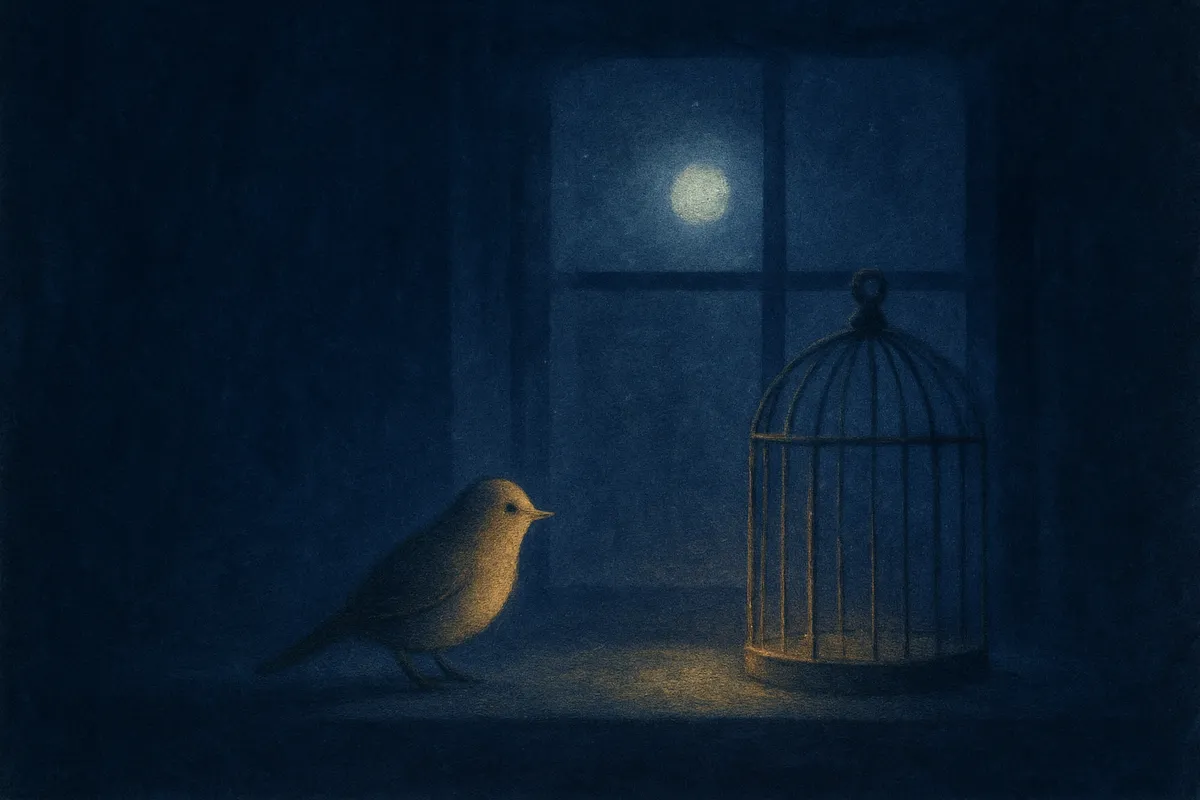
Birds are the messengers of every dream book. Wherever dreams have been written down, a bird meant word on the way — news, tidings, a letter, a voice arriving from somewhere else. But every canon also pauses on one entry longer than the rest, and it isn't the bird in the sky. It's the bird in the cage.
What the traditions say
The European folk books kept the messenger reading almost intact for centuries: birds flying toward the dreamer, tidings arriving; flying away, a matter departing; birdsong, good word from afar. Dark birds gathered darker readings, but the books read most birds kindly. And then the entry that breaks the pattern: a caged bird meant confinement — a voice kept from singing.
The Islamic tabir tradition read birds more richly still — as one's deeds, provision, or news, graded by the bird and its bearing. A fine bird alighting: honor, or a glad word arriving. An unknown bird taking something from the house was read gravely. And the tradition holds a quiet mirror to the cage: releasing a bird read as a matter concluded and let go.
The Polish sennik canon is, as usual, concrete: birds are tidings; a flock is social bustle, invitations, noise; a bird at the window, word arriving from close by; feeding birds, generosity returned in reputation. And the caged bird — someone's freedom curtailed, perhaps the dreamer's own.
What psychologists notice
Psychologists read birds as the light, quick contents of the mind given wings — hopes, ideas, messages to oneself. A flock tends to track a busy social season; a single still bird, a thought waiting to be noticed.
But the caged bird is the entry psychologists take most seriously: a voice or ambition kept confined. Not lost — confined. The bird in the cage is usually alive and often singing; the dream is rarely about whether the thing exists, and almost always about why it isn't allowed out.
A question to sit with
What have you been keeping quiet lately — an opinion, a plan, a talent — because the moment never quite seems right? That's usually who's in the cage.
If birds flew toward or past you
The old direction-reading is the purest form of the messenger entry: toward you, tidings coming; away or past, a matter leaving your hands. It's also the reading most likely to tempt you into treating the dream as a forecast — and our position on that is a friendly no. What the direction more honestly maps is your own attention: whether you're waiting for something to arrive, or watching something go.
If the bird was caged
This is where the reader's real material usually lives. The folk books said confinement, a voice kept from singing; the sennik canon says freedom curtailed, perhaps your own; psychologists hear a voice or ambition kept confined. Notice the details the dream chose: was the door locked, or just closed? Did the bird sing anyway? Whose house was the cage in? The tabir tradition supplies the other half of the entry — releasing a bird as a matter concluded and let go — which is why the open cage door is worth as much attention as the cage. A caged bird is, in a sense, the inverse of the dream where you yourself are flying: the same wish, held instead of used.
If you heard birdsong
The kindest line in the entry: the folk books read birdsong as good word from afar. If the singing came from the cage, the readings combine in an oddly hopeful way — the confined voice is still a voice, and it still carries.
If the bird was dark or still
The folk books gave dark birds their darker shadings, though they read most birds kindly — and the tabir tradition was gravest about an unknown bird carrying something away. The modern reading of a still or silent bird is gentler and, for most dreamers, more useful: a thought waiting to be noticed. Something in your life has gone quiet — a project, a correspondence, a hope — and the dream is holding it up, not pronouncing on it. Quiet is a state, not a sentence.
A dictionary can tell you what birds mean in general. It can't hear that yours sat at your childhood window, or that the cage door was open the whole time. That's the part only your own dreams, remembered together, can answer — and it's exactly what Dreamlock is built for, coming soon to iPhone. Until then, the habit that matters most is simply catching the dream before it fades.