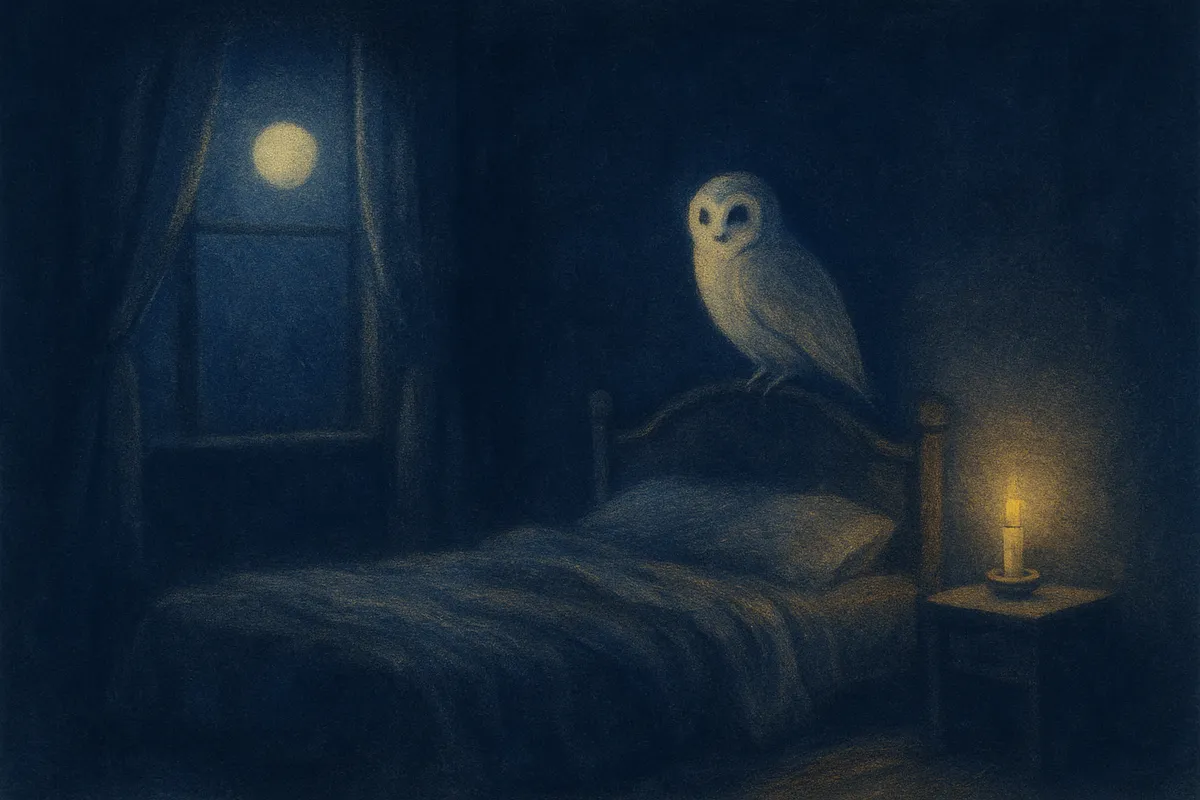
Most birds enter dreams as messengers. The owl enters as something else — a watcher, already there when you notice it, already looking at you. Whether that gaze is a warning or a kind of company is exactly where the old dream books part ways.
What the traditions say
The European folk books mistrusted the night bird. An owl meant solemn news, a warning carried quietly after dark — the classical world read its call near a house as an ill sign, and the dream books inherited the caution. Yet even here the entry is double: the owl of Athena allowed a second reading, wisdom in dark circumstances, counsel arriving when ordinary light fails.
The tabir tradition breaks with the dread entirely. The folk fear of the owl as omen was not its method; the books read the bird itself — a solitary, formidable figure. In some transmissions, an awe-inspiring man without followers; in others, a thief who works alone by night. Either way: watchful, isolated, and best not made an enemy. It's one of the cleaner disagreements in the canons — one tradition hears a portent, the other sees a person.
The Polish sennik keeps the old village ear but splits the entry by behavior. An owl calling is solemn news, or a warning to attend to matters of the house. An owl seen silent is wisdom nearby — advice worth seeking from the old. And an owl by day is something hidden made briefly visible.
What psychologists notice
Psychologists read the owl as the one who sees in the dark. Owl dreams tend to appear around knowing — something perceived quietly, before it can be said aloud — and they often accompany intuitions the dreamer has been discounting. The old association with omen usually reads inward here: not a forecast, but the sense that some watching part of yourself has understood something and is waiting for the rest of you to catch up.
That's also why owl dreams so often feel accurate in hindsight. The knowledge was already yours; the dream just gave it a pair of eyes and set it somewhere you couldn't ignore it.
A question to sit with
What do you already know that you haven't let yourself say yet — even privately? That's usually what the owl is looking at.
If the owl called or hooted
The call is the hinge of the whole entry. The folk books and the sennik both darken here: solemn news, a warning after dark, matters of the house needing attention. The modern reading keeps the urgency and drops the doom — a quiet signal from yourself that something wants tending. If the call is what you woke remembering, ask what in your house — literal or otherwise — you've been meaning to look at.
If the owl was silent and watching
Here every canon softens. Silent, the owl is Athena's bird in the folk books and wisdom nearby in the sennik; even the tabir's solitary figure is watchful rather than hostile. Dreamers often describe these dreams as strangely calm — observed, but not judged. The counsel reading is worth taking half-literally: is there an older, quieter voice you've been meaning to consult?
If you saw the owl by day
The sennik's line — something hidden made briefly visible — is the one to sit with. Daylight owls in dreams tend to coincide with glimpses: a side of someone you weren't meant to see, a motive surfacing, a truth of your own standing briefly in the open. The glimpse closes fast. Note what else was in the dream before it fades.
A dictionary can tell you the owl means warning to one tradition and wisdom to another. It can't tell you which one your owl is — that depends on when it visits you and what it sits beside, a pattern only your own dreams can show. That's what Dreamlock is being built to hold. And if the omen question still nags, our honest answer lives here: do dreams predict the future?