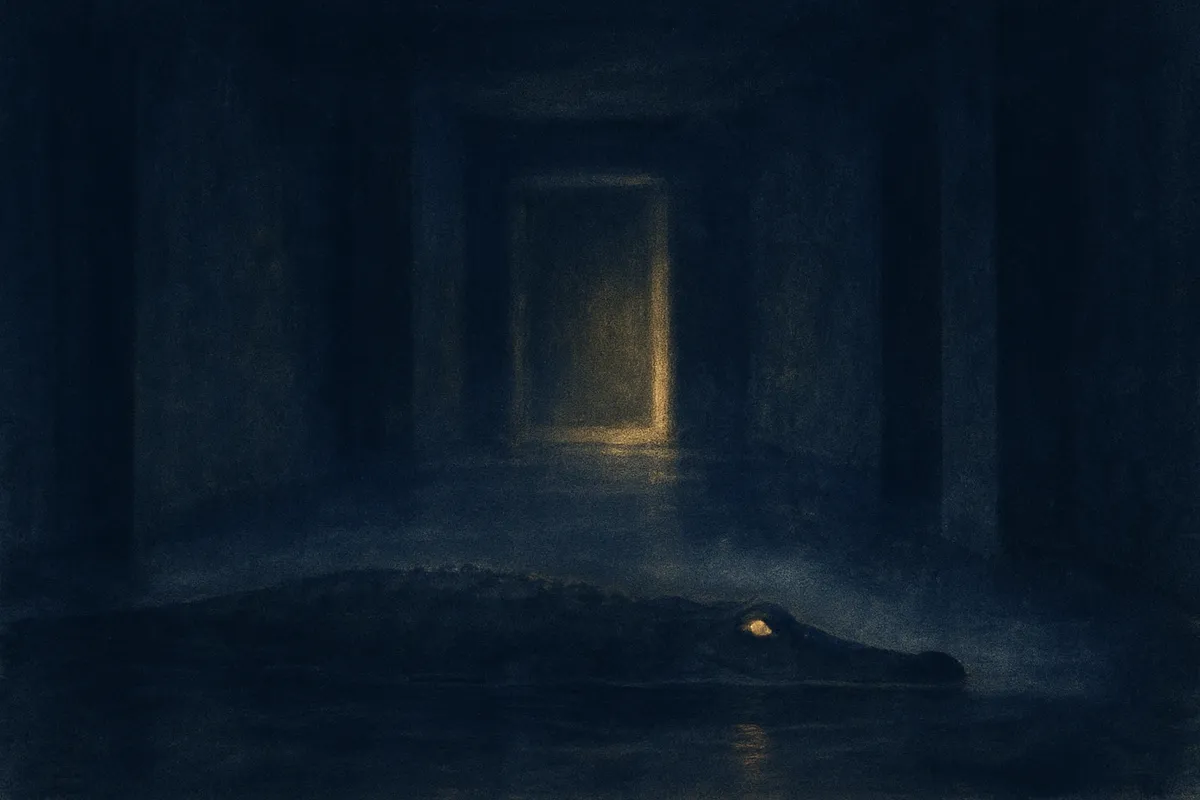
Dreamers say crocodile or alligator depending on which rivers raised them, and the dream doesn't much care: the animal is the same idea in either word, a danger lying exactly level with the water, showing only its eyes.
| Variant | What the old books read | Source |
|---|---|---|
| A crocodile attacking you | The person it stands for doing the same to the dreamer | Artemidorus |
| Killing a crocodile or alligator | The one way out of an unfavourable dream | Miller 1901 |
| Stepping on its back | Trouble that takes a mighty struggle to escape | Miller 1901 |
What does it mean to dream about a crocodile or alligator?
Artemidorus, in Krauss's 1881 translation, was blunt: the crocodile meant a pirate, a murderer or a man no less wicked. And he read it by correspondence: however the crocodile treated the dreamer, so the person it stood for would treat them. The Golden Wheel Dream-Book (1862), in a short entry, read pirates, robbers by sea or deceitful persons, and troubles.
Miller's 1901 dream dictionary was more emphatic still. As surely as one dreamed of a crocodile, he wrote, one would be deceived by one's warmest friends and assailed by enemies at every turn, and he advised withholding confidence even from friends. For once the books barely disagree. They differ only in where they point: Artemidorus at a stranger, Miller at the people closest.
What the crocodile did
These are readings from the old dream books, reported as history — no dream foretells the future.
What does it mean to dream of a crocodile attacking you?
The lunge from still water is the scene most people remember. For Artemidorus the attack was the reading itself: whatever the crocodile did to the dreamer, the pirate, murderer or wicked person it signified would do in the same way. Psychologists read it as a danger you've sensed for a while finally showing itself, often from a direction that looked calm.
Was your dream different? Dreamlock reads the one you actually had →
What if the crocodile attacked and you escaped?

Escaping changes the ending, and dreamers remember the scramble to the bank. The books cited here read the attack but not the escape. The modern reading is resilience: a threat seen in time and got clear of. If the chase is what you remember most, the dream borders on being chased.
Was your dream different? Dreamlock reads the one you actually had →
What if the crocodile was still or sleeping?
The most unnerving version: nothing moves. Artemidorus, Miller and the Golden Wheel don't read a still or sleeping crocodile. Psychologists hear a danger that is real, present and not yet moving, like the snake under the table. Some situations are best mapped before they're touched, and this dream is often the map.
Where you met it, and what you did
What if you were in the water with it?
Dreamers in this variant often say the worst part wasn't the animal but the water itself. None of the three books reads the setting. The modern reading is a contest already entered on someone else's terms: a negotiation, a workplace or a relationship where you don't know the bottom and can't see what moves in it.
Was your dream different? Dreamlock reads the one you actually had →
What does it mean to dream of killing a crocodile?
Killing the animal is the only happy ending Miller allows. Miller's "Alligator" entry put it in one line: "To dream of an alligator, unless you kill it, is unfavorable to all persons connected with the dream," and he called it a dream of caution. Psychologists hear a threat finally confronted instead of watched, often with relief more than triumph.
What if you stepped on its back?
Stepping onto what you took for a log is the dream's cruellest trick. Miller read stepping on a crocodile's back as falling into trouble from which the dreamer had to struggle mightily to get free, and he urged heeding it as a warning. The modern reading is close: a commitment made before you saw what you were standing on.
What does a crocodile dream mean psychologically?
Psychologists keep the water and drop the villain. The crocodile is danger under a calm surface, patient and mostly hidden, and crocodile dreams tend to arrive alongside threats sensed but not seen: a situation, or a temper, that shows only its eyes. Readers in Jung's line hear very old instinct, unchanged and unimpressed by everything built above it.
It's worth saying that the temper in question isn't always someone else's. Some dreamers eventually recognise the patience in the water as their own. What you did in the dream (froze, fled, fought) usually says more than the animal.
A question to sit with
Where in your life is something being very, very still, and are you mistaking that stillness for peace?
Artemidorus could name what the crocodile stood for in general. Which water keeps returning in your dreams, and whose voice you hear when the surface goes still, is a pattern only your own dreams can show. Dreamlock, on the App Store for iPhone, is built to follow it: it listens to the dream you record, paints it, and remembers every crocodile that surfaces again.