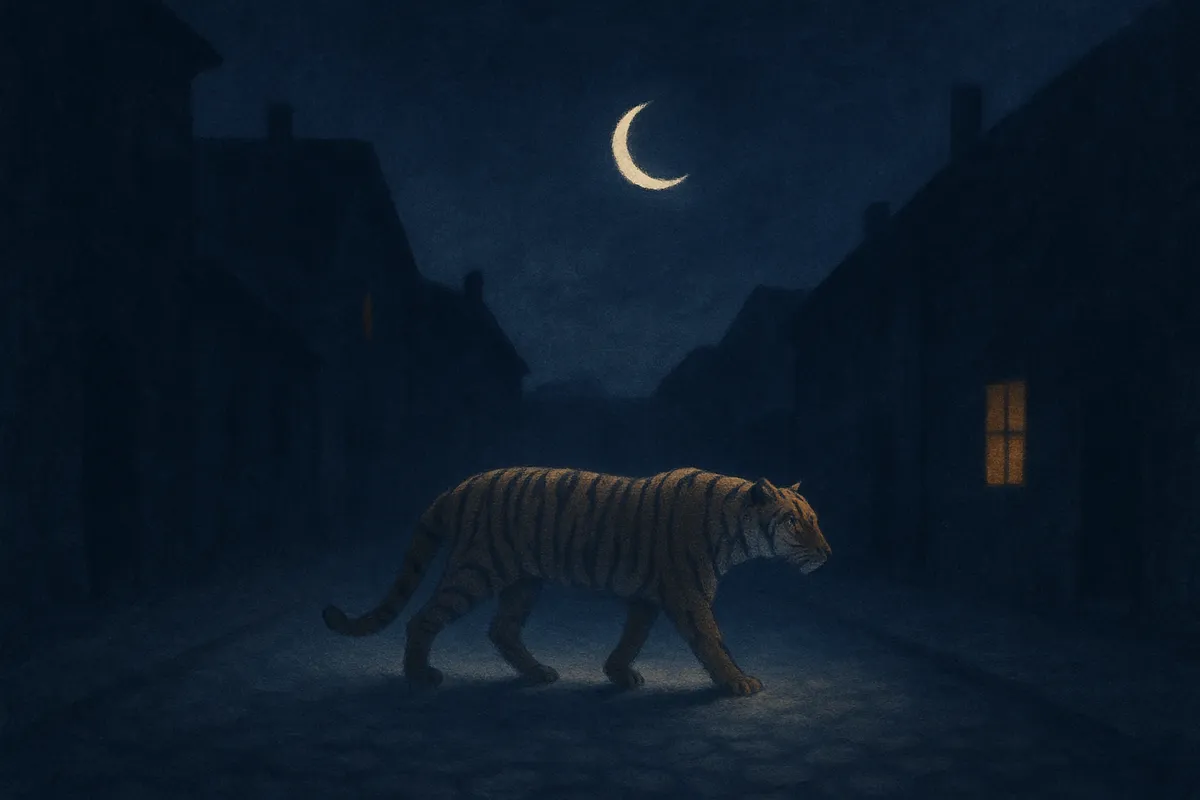
A tiger dream is rarely confused with a lion dream. The lion arrives like an institution; the tiger arrives like a mood: beautiful, silent, and not obviously on anyone's side. Dreamers tend to remember exactly where it was looking.
| Variant | What the old books read | Source |
|---|---|---|
| A tiger attacking | Failure and gloom; a treacherous friend | Miller 1901; Golden Wheel 1862 |
| A tiger running away | Opposition overcome, high positions | Miller 1901 |
| A tiger in a cage | Adversaries foiled | Miller 1901 |
| A tiger-skin rug | Luxurious ease and pleasure | Miller 1901 |
What does it mean to dream about a tiger?
The two English-language dream books cited here read the tiger as an enemy, then argued about whether the enemy won. Miller's 1901 dream dictionary (Ten Thousand Dreams Interpreted) graded his entry by what happened: a tiger advancing meant torment and persecution by enemies, an attack meant failure, but a tiger warded off, killed, fleeing or caged meant success. Several of his branches are favourable, which surprises many people who look it up.
The Golden Wheel Dream-Book (1862) was gloomier and more personal. It read tigers as treachery in both its branches: a tiger in a rage meant a treacherous friend who would endanger the dreamer's reputation, a quiet or sleeping tiger a meeting with an unworthy person. A girl who dreamed of tigers was told to be wary of her next admirer.
So one book watched the fight and the other watched the friends. Neither asked whether the tiger might be the dreamer's own; that question belongs to psychology.
What the tiger did
These are readings from the old dream books, reported as history — no dream foretells the future.
What does it mean to dream of a tiger chasing you?
It follows through tall grass or empty streets, never quite catching up. Miller and the Golden Wheel read the tiger's attack and flight, not a pursuit. The modern reading shares a floor with being chased: the distance between you and the tiger is often the distance you keep from a feeling or a person in waking life. Worth noting whether you ever turned around.
Was your dream different? Dreamlock reads the one you actually had →
What does it mean to dream of a tiger attacking you?
Claws, weight, no time to run. Miller wrote that "If it attacks you, failure will bury you in gloom", but read warding it off or killing it as great success in all the dreamer's undertakings. The Golden Wheel read a tiger in a rage as a treacherous friend. Psychologists hear strong feeling breaking through, anger or desire that has stopped waiting.
Was your dream different? Dreamlock reads the one you actually had →
What does it mean to dream of a tiger running away from you?
The tiger turns and is gone. Miller read a tiger running away from the dreamer as overcoming opposition and rising to high positions, one of several favourable branches in his entry. The modern ear hears a threat that shrank once faced, or a force in yourself you've stopped feeding.
Caged tigers and tiger skins
What does it mean to dream of a tiger in a cage?
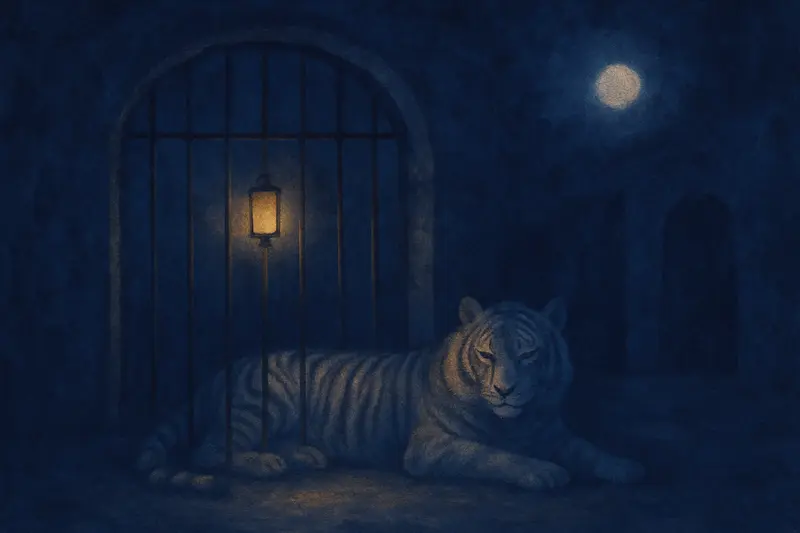
Bars, a slow pacing, eyes on you. Miller read seeing tigers in cages as the dreamer foiling their adversaries, opposition held in check. Psychologists turn the image round: strong feeling, anger, passion, ambition, pacing its cage. The question the dream raises isn't whether the force exists, but how long the cage will hold.
Was your dream different? Dreamlock reads the one you actually had →
What does it mean to dream of a tiger-skin rug?
The tiger flattened on a floor, stripes underfoot. Miller read seeing rugs of tiger skins as a sign "that you are in the way to enjoy luxurious ease and pleasure", the only line in his entry with no enemy in it. The modern reading is more ambivalent: power turned into decoration, a wildness tamed, or a comfort paid for by something fierce.
What does a tiger dream mean psychologically?
Psychologists read the tiger as ferocity with beauty. Tiger dreams tend to accompany strong feeling held barely in check: anger, passion, ambition pacing its cage. Many dreamers find the tiger's attention matters most. Stalked, the dreamer fears a force; walking beside it, they are learning to carry one.
The beauty matters too. Dreamers rarely describe the tiger with disgust; the fear comes braided with admiration, which is often a sign the force in question is partly their own. In a Jungian reading, the thing we fear in the dream is often the energy we haven't yet claimed.
A question to sit with
What have you been keeping impressively calm about lately? Notice whether the calm feels like peace, or like pacing.
Whether your tiger paces the same hallway every time, and what was happening the weeks it came back, is beyond any entry in Miller. That pattern lives across your own dreams, seen side by side over a season or two. It's what Dreamlock, on the App Store for iPhone, is built for, and why a dream that returns deserves more than one look.