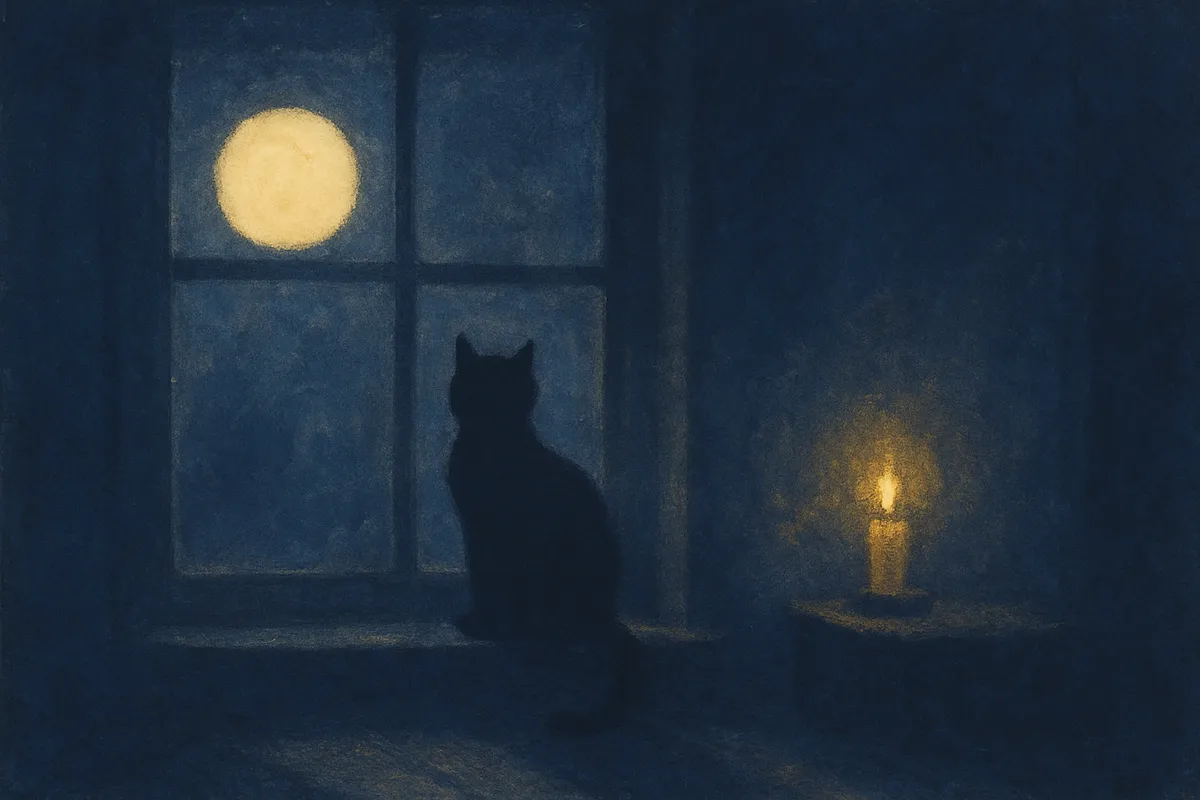
Here is the strange thing about cat dreams: the dreamer usually loves the cat, and the old dream books almost never did. For centuries the manuals filed the cat under cunning — flattery with claws, falseness nearby — while the person waking from the dream remembers warmth on the blanket and wants to know why it felt so good. Both readings are real. The gap between them is where this symbol gets interesting.
What the traditions say
The old European folk books were wary of cats. A purring cat read as sweet words to be weighed — pleasant, and not necessarily sincere. A scratching cat: a quarrel with someone close. Kittens softened the entry toward small domestic pleasures, but the adult cat kept its reputation for cunning. The Polish sennik canon is the bluntest of all: cat — falseness nearby; a purring cat, flattery with a purpose.
The Islamic tabir tradition reads the cat domestically instead — a creature of the household's edges. At its best, a guard against vermin; at its worst, a household pilferer. A cat stealing from the house read as small losses from close by; a calm cat at rest, the household in order. It's a quieter entry than the snake's, but it points the same direction the others do: whatever the cat means, it means it inside your own walls — the same intimate territory as a dream about your house.
Notice what all three agree on: the cat's meaning lives close to home. None of the old books read it as a distant threat. The suspicion, where there is suspicion, is aimed at your own circle.
What psychologists notice
The modern reading rescues the cat from the old books' distrust — without quite contradicting them. Psychologists tend to hear the cat as independence and affection on its own terms: cat dreams cluster around relationships where closeness can't be commanded, including the dreamer's relationship with their own needs. In the Jungian line the cat carries instinct that won't be trained — the part of you that cooperates only when it chooses to.
That resolves the tension neatly. The old books read the cat's self-possession as insincerity; the modern ear hears the same self-possession as honesty of a rarer kind. A cat that ignores you often reads truer than a cat that attacks — it's the dream staging the exact experience of wanting closeness you can't compel. Where a dream of being chased is about what pursues you, the cat dream is usually about what won't.
A question to sit with
Where in your waking life are you waiting for affection that only arrives on someone else's terms — and is that someone else, or is it you?
If the cat was affectionate
Take the warmth seriously before you take the warning. The folk books would have you weigh the purr — sweet words with a purpose — and that's worth a moment's honesty about who has been unusually charming lately. But the modern reading is gentler: affection freely offered by a creature that didn't have to offer it. If the dream felt like rest rather than seduction, it probably was. How you felt on waking is the better guide than any dictionary entry.
If it scratched or ignored you
Two different dreams, and the quieter one usually cuts deeper. The scratch is the folk books' territory — a quarrel with someone close, friction inside the household — and it tends to surface when a warm relationship has a sharp edge you've been politely not mentioning. Being ignored is the psychological reading's home ground: closeness withheld, attention you can't summon. Dreamers often report the ignoring version as the more painful, which tells you something about what the dream is actually rehearsing.
If it was a kitten
The one variant every tradition softens for. Small domestic pleasures in the western books; small mischief, mostly charming, in the sennik canon. The modern reading hears something newly begun that needs looking after — and, like a dream of a baby, it isn't always about a literal creature. Ask what in your life is young, half-wild, and yours to raise.
A dictionary can tell you what cats mean in general — the old distrust, the modern affection. It can't see that yours sat on your childhood windowsill, or that it appears every time a certain friendship cools. Whether your dreams tend more toward the cat or the spider — and what either is doing there — only shows up across many dreams, remembered together. That's what Dreamlock is being built for: it listens to the dream you mumble at 3 a.m., paints it, and keeps your own symbol index as it grows. Coming soon — and in the meantime, remembering the dream at all is the place to start.