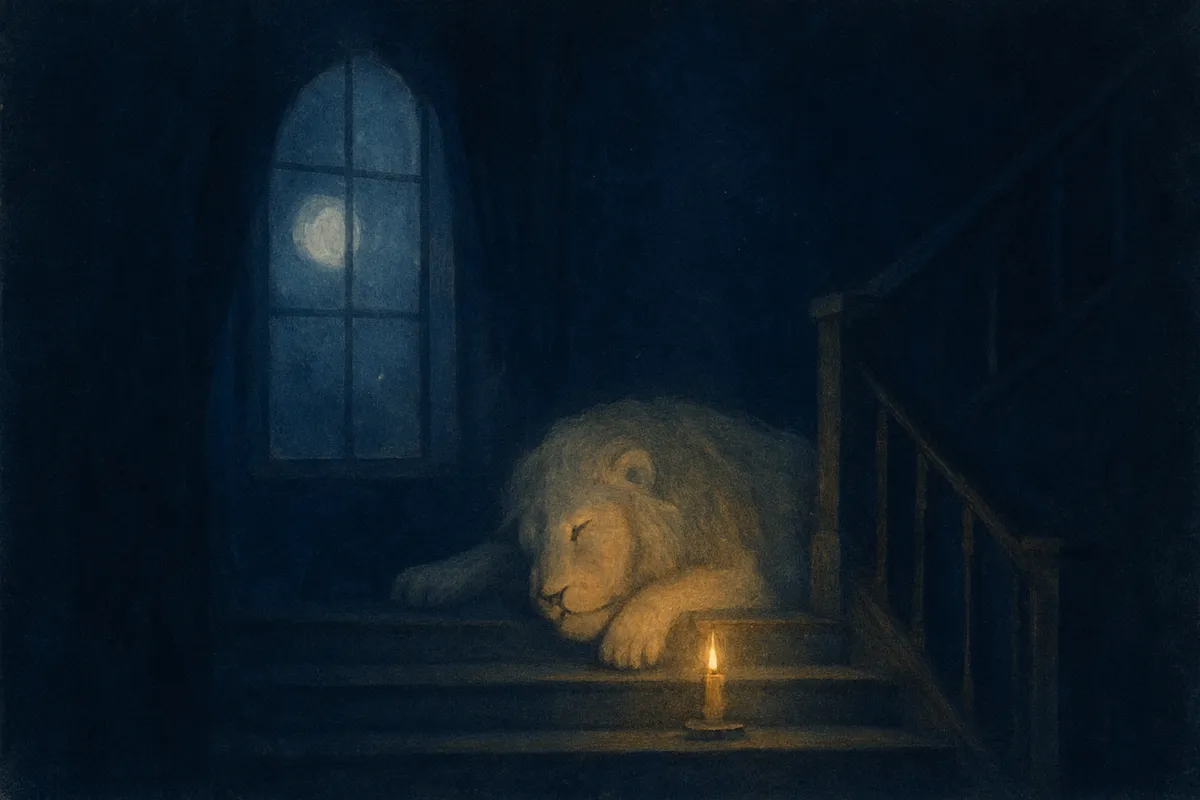
A lion does not enter a dream quietly. Dreamers describe these dreams with a strange formality, the lion in the garden, the lion on the stairs, as if the animal brought its own occasion with it. Artemidorus and Miller felt the same gravity, and they read nearly every lion as a question of power: whose it was, and who mastered whom.
| Variant | What the old books read | Source |
|---|---|---|
| A lion attacking you | Fear; jealous people; enemies succeeding | Artemidorus; Golden Wheel 1862; Miller 1901 |
| A lion roaring | Unexpected advancement; jealous people | Miller 1901; Golden Wheel 1862 |
| A tame lion | Luck and gain; rising easily in the world | Artemidorus; Golden Wheel 1862 |
| Riding a lion | Courage and persistence | Miller 1901 |
| Overpowering a lion | Victory in any engagement | Miller 1901 |
| A lion cub | The birth of a boy; new enterprises | Artemidorus; Miller 1901 |
| A lioness | The lion's meaning, in a lesser degree | Artemidorus |
| A caged lion | Success that depends on meeting opposition | Miller 1901 |
What does it mean to dream about a lion?
Artemidorus, whose Oneirocritica (2nd century) we cite in Friedrich Krauss's 1881 German translation, placed the lion among the magnanimous, freedom-loving, energetic and fearsome animals, and read such animals as people of the same kind. His lion was a person of power, and whether it helped or harmed depended entirely on its temper: tame and wagging, or threatening and raging.
Miller's 1901 dream dictionary (Ten Thousand Dreams Interpreted) began more abstractly: "To dream of a lion, signifies that a great force is driving you." The rest of his long entry is a contest. Subduing, controlling or riding the lion reads well; being overpowered by it reads badly. The Golden Wheel Dream-Book (1862) framed the lion as the king of beasts and read the dreamer's rise in the world through its mood.
The roaring lion shows where they part: Miller heard advancement in the roar, the Golden Wheel heard jealousy. Taken together, the books agree the lion is power; they argue over whether its noise is for you or against you.
What the lion did
These are readings from the old dream books, reported as history — no dream foretells the future.
What does it mean to dream of a lion attacking you?
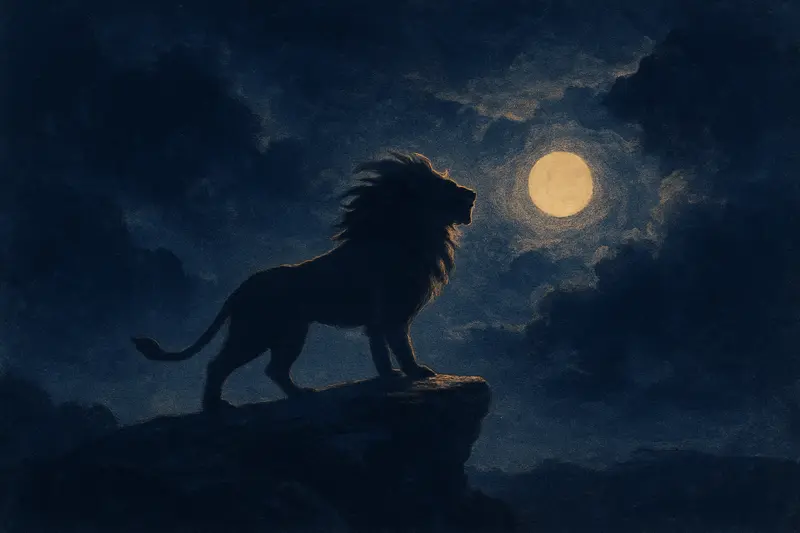
It springs, and there is nowhere to go. Artemidorus read a threatening or raging lion as fear, and also as illness, since illness too could be likened to a savage beast; that is a record of old fears, not a statement about anyone's health. The Golden Wheel read an angry lion trying to reach the dreamer as a rise shadowed by envy: "jealous people will annoy and try to injure you." Miller read being overpowered as being open to enemies' attacks. Psychologists hear someone else's power aimed at you.
Was your dream different? Dreamlock reads the one you actually had →
What does it mean to dream of being chased by a lion?
Here the lion doesn't strike; it follows, and you run. The three books read what the lion does to the dreamer and who wins, but none describes a chase. The modern reading is avoidance with a crown on: a confrontation with someone whose authority feels larger than yours, postponed. How you ran, and whether you turned, is worth more than the fact of the chase.
Was your dream different? Dreamlock reads the one you actually had →
What does it mean to dream of a lion roaring?
The sound arrives before the animal. On the roar, the books split cleanly. Miller's 1901 dream dictionary read it well: "To hear the roar of a lion, signifies unexpected advancement and preferment with women." The Golden Wheel Dream-Book (1862) set its roaring, angry lion among jealous people who would try to do the dreamer harm. Psychologists hear a voice that can't be ignored, your own claim to space or someone else's.
What you did with the lion
What does it mean to dream of a tame lion?
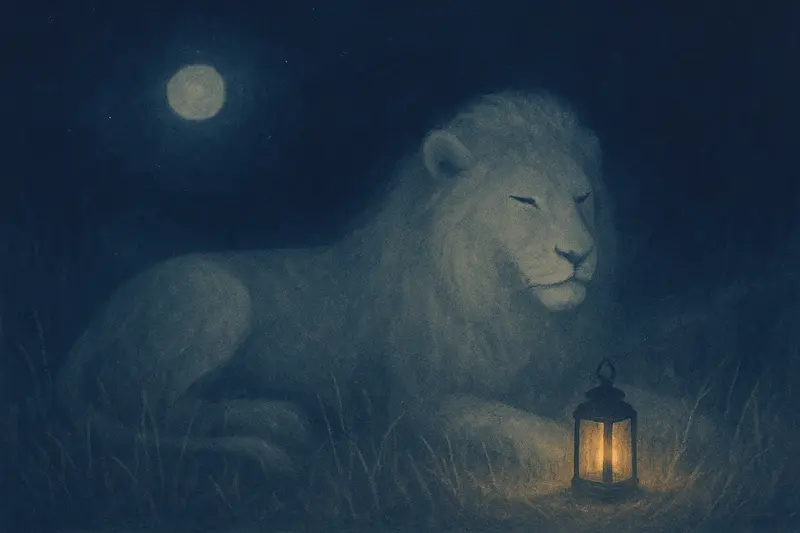
The lion lies down, or walks beside you like a dog. Artemidorus read a tame, tail-wagging lion approaching peacefully as luck and gain: for a soldier from the king, for a private man from the ruler. The Golden Wheel read the king of beasts looking mild and gentle as the dreamer rising easily to a better position. Psychologists ask what large force in your life is currently at rest, and what keeps it that way.
Was your dream different? Dreamlock reads the one you actually had →
What does it mean to dream of riding a lion?
On its back, holding on to the mane. Miller's 1901 dream dictionary was brief and warm: "To ride one, denotes courage and persistency in surmounting difficulties." It sits with the other branches of his entry in which the dreamer masters the animal, all read well. If this was your dream, it may be worth asking what difficult thing you have recently stopped fearing and started steering.
What does it mean to dream of overpowering a lion?
You wrestle it down, or stand over it. Miller's 1901 dream dictionary did not describe killing the lion, but read subduing one as victory in any engagement, and seeing a man control a lion, caged or free, as success in business and great mental power. Psychologists hear strength claimed: a force you once feared, or a fierce part of yourself, brought under your own direction.
Cubs, lionesses and caged lions
What does it mean to dream of a lion cub?
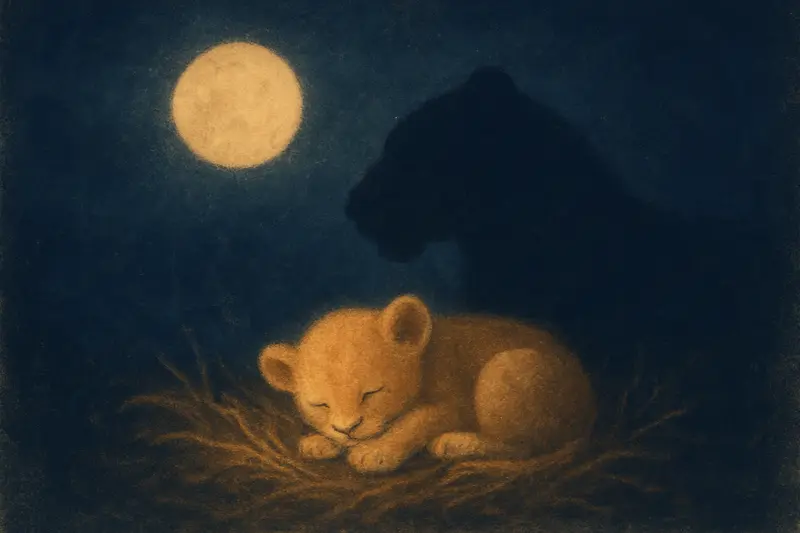
Small, soft-pawed, already a lion. Artemidorus read young lions as good for everyone, since the dream mostly announced the birth of a boy. Miller's 1901 dream dictionary read them as "new enterprises, which will bring success if properly attended," and, for a young woman, as new and fascinating lovers. Psychologists hear power in its early form: a project or a strength of yours that needs care before it can roar.
What does it mean to dream of a lioness?
She hunts, or watches, or guards her cubs. Artemidorus read the lioness as meaning what the lion meant, only in a lesser degree: wagging, she promised gain; threatening or biting, harm, but from women rather than men. He added that she often stood for rich people of ill repute. Psychologists tend to hear protective strength, often a mother or a fierce woman in the dreamer's life, or that fierceness in the dreamer.
What does it mean to dream of a caged lion?
Bars between you, and the lion pacing. Miller's 1901 dream dictionary read caged lions as success that "depends upon your ability to cope with opposition". Psychologists read the cage both ways: power held safely at a distance, or a strength of your own you keep locked away, and which of the two it felt like is the honest part of the dream.
What does a lion dream mean psychologically?
The lion tends to arrive when questions of authority and self-possession are active, when you are either claiming power or feeling pressed by someone else's. Jung read the lion as solar energy, courage, the regal aspect of the self, and the question the dream keeps asking fits him: are you ruling your own inner kingdom, or ceding it? A frightening lion and a magnificent one may be the same lion, seen from opposite sides of that question.
That is also why Miller's fixation on mastery still reads well. Attacked, chased, tamed, ridden: the scenes run along one line, from power over you to power in your hands, and your dream usually shows where on that line you stand.
A question to sit with
Where in your life right now is there a power you're circling, one you could either stand before or run from? Notice which of those you did in the dream.
Artemidorus sorted lions by temper, tame or raging. Yours may have worn the face of your director, or slept on your childhood staircase, and only your own dreams, remembered side by side, can show which lion keeps returning and why. It's what Dreamlock, on the App Store for iPhone, is built for: it listens to the dream you record, paints it, and remembers every lion that comes back.