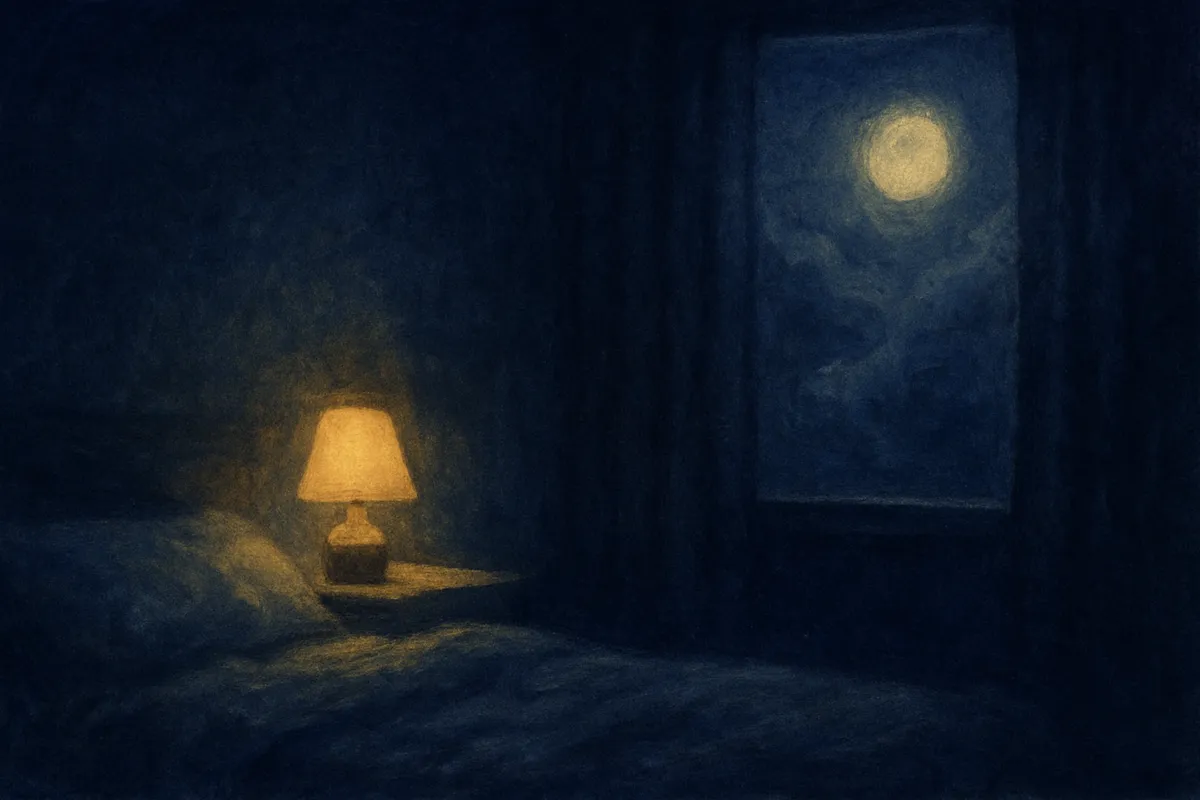
You wake at three in the morning with your heart going, the room briefly unfamiliar, the dream still vivid enough to touch. Whatever it was — the chase, the fall, the terrible news delivered in a calm voice — it felt less like a dream than an event.
Nightmares are the dreams people most want explained and most want gone. The honest news is good on both counts: what they are is well understood, and what helps is simple.
What a nightmare actually is
A nightmare is not a different species of dream. It's ordinary dreaming — the same nightly work of sorting feeling and memory — handling difficult material with the volume turned up. The dreaming mind takes what's heavy and unfinished and gives it a story, and when the material is hard, the story is hard. Psychologists tend to describe this as the emotional system doing its job on rough terrain: not malfunction, but effort.
That framing matters, because the fear a nightmare leaves behind usually comes with a second fear on top — what's wrong with me? Almost always: nothing. Nightmares are close to universal. Children have them most, nearly everyone has them sometimes, and stressful stretches of life reliably bring them out. A nightmare is evidence that your mind is working on something, which is what minds are for.
Nightmares also cheat, memorably. They wake you mid-scene, so you catch them vivid and unfinished, while gentler dreams dissolve unremembered inside sleep. Strong emotion then fixes the images in memory. The result is a skewed highlight reel: it can feel like you dream mostly darkness when you've simply kept mostly darkness.
Why hard days make hard nights
Dreams run on your material, so a difficult season shows up on the night shift — that much is unsurprising. But nightmares also follow humbler physical weather. Broken and irregular sleep makes dreams stranger and more intense. Dreaming grows longer and more vivid toward morning, which is why the worst dreams so often come just before waking. A late heavy meal, an intense film, doomscrolling until midnight — all of it is raw material handed to the night shift at the last minute.
This is oddly comforting. It means a run of bad nights often has boring causes, and boring causes have boring, workable fixes.
What genuinely helps
None of this is dramatic, which is rather the point.
Keep sleep steady. Regular bed and wake times, even on weekends. Nothing calms the night shift like a predictable schedule — most of what makes dreams frantic is fed by ragged sleep.
Wind down on purpose. Give the last hour a lower volume: dim light, no feeds, nothing designed to alarm you. What you carry across the threshold of sleep is disproportionately what gets dreamed.
Write the nightmare down — in daylight. A nightmare at 3 a.m. fills the whole room; the same nightmare at 9 a.m., in your own handwriting, is four sentences about being chased through a parking garage. Putting it on the page moves it from something happening to you to something you can look at. If morning recall is the hard part, the guide on remembering dreams covers it.
Give it a different ending. This is the technique sleep researchers most often suggest, and it's disarmingly simple: while awake and calm, replay the nightmare and deliberately imagine it ending another way. The door opens onto a beach. The pursuer, turned to face, is a confused delivery man. Rehearsed by day, the new version has a way of following you to sleep — dreams, it turns out, take editorial suggestions.
And one plain sentence that belongs in any honest page on this subject: if nightmares regularly wreck your sleep or your days, that's worth raising with someone you trust — a doctor included.
When the same nightmare returns
Some nightmares are one-night visitors; others come back — the same pursuit, the same fall, the same loss replayed. A returning nightmare follows the logic of any returning dream: it tracks something unresolved that keeps returning in waking life, and it tends to loosen when that situation moves. That pattern has a guide of its own — why recurring dreams come back — and dreams of loss in particular are common enough, and old enough, to fill the page on dreams about death.
The nightmare on the page is smaller
Here is the quiet trick at the center of all of this: a nightmare survives on vagueness. Left unexamined, it stays a mood — enormous, wordless, waiting for tonight. Written down and placed among the rest of your dreams, it becomes one entry in a larger, mostly stranger, often funnier record, and it shrinks to its actual size: one hard dream in a dreaming life.
That's the spirit Dreamlock is built in — mumble the dream into your phone before it fades, and by morning it's a card: a clean retelling, a painting, the symbols it found. Not to dwell on the dark ones, but to file them where they belong — among all the nights that held nothing frightening at all.