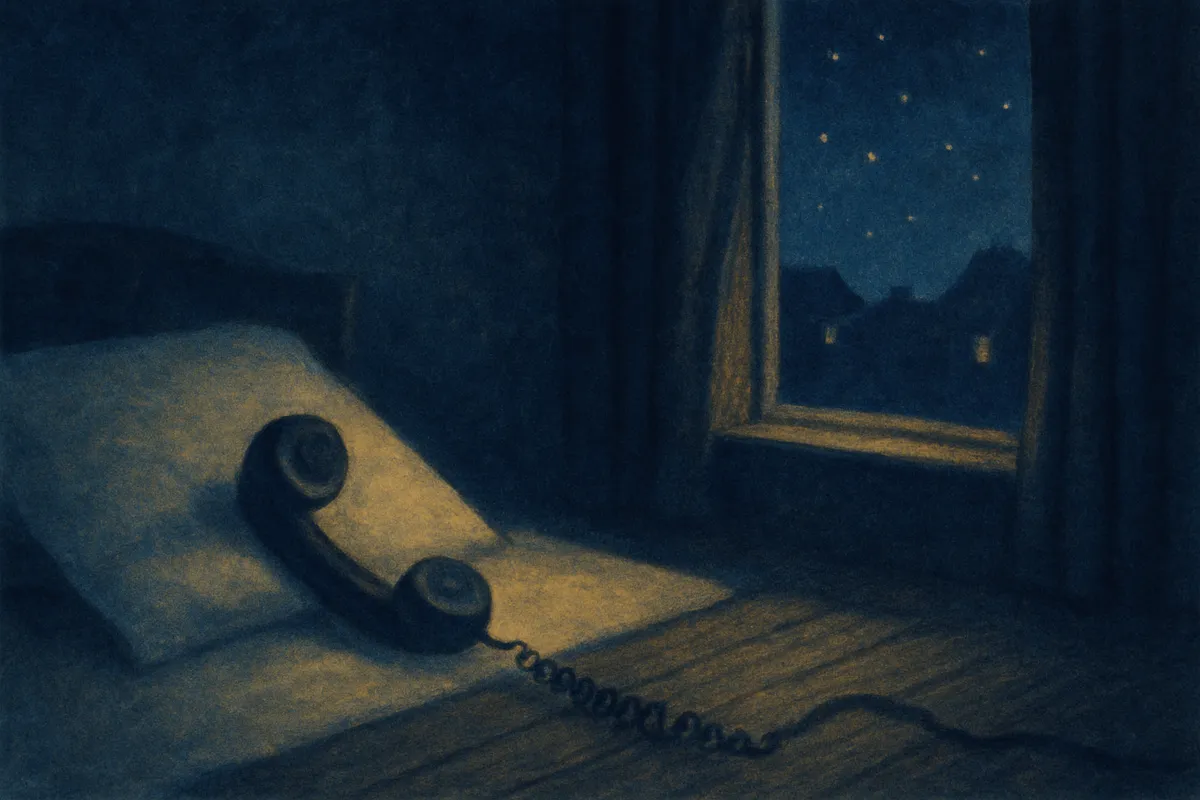
Someone you share a roof with has probably delivered the news over breakfast: you were talking last night. Maybe it was a full sentence, maybe a mutter, maybe your own name spoken with strange formality. And you remember none of it.
That gap — a voice that was unmistakably yours, saying things you'll never recall — is unsettling enough that sleep talking has collected a small mythology: that it reveals secrets, that it means something is wrong, that the sleeper can be interrogated like a witness. Almost all of it dissolves on contact with what sleep talking actually is.
What sleep talking actually is
Sleep talking — somniloquy, if you want the elegant word — is simply speech produced during sleep, and it is one of the most ordinary things a sleeping person can do. It's most common in childhood, and most people talk at least occasionally at some point in their lives. It runs in families. It tends to increase when sleep is under pressure: stress, short nights, irregular hours, fever.
One detail surprises people: it isn't confined to dreaming. Sleep talking happens across the stages of sleep. Speech during dreaming sleep may echo the dream in progress — the sleeper answering someone only they can see. Speech from deep, dreamless sleep is often just fragments, words without a story behind them. From the outside, you usually can't tell which kind you're hearing.
Why does it happen at all? During sleep the body ordinarily keeps speech switched off along with everything else; in a sleep talker, that mute switch simply slips for a moment. Nothing breaks, nothing malfunctions — a few words escape through a door that usually stays shut, and then it shuts again.
Episodes are brief — a few seconds, sometimes less — and the talker almost never remembers them. The voice was theirs; the memory never existed. That's also why asking someone "do you know you talk in your sleep?" so often produces genuine astonishment: you could do it nightly for years and be the last to find out.
What sleep talkers actually say
Here the mythology takes its hardest hit, because the answer is: not much.
People who have listened closely to sleep speech find it overwhelmingly mundane and frequently garbled — half-sentences, mumbles, everyday words, stretches of sound that never resolve into language at all. There's a fair amount of grumbling and arguing, as if the sleeper were mid-negotiation with someone unhelpful. What there isn't, reliably, is revelation. The sleeping brain is not reading aloud from a diary; it's murmuring along to its own half-lit business, and most of that business is as banal as anyone's.
Which is worth holding onto if you've been on the listening side of something that stung — a name, a phrase, an apology addressed to nobody in the room. Dreams are cast from whoever happens to be on the mind, and people turn up in them for every reason and no reason: an old colleague, a stranger from the supermarket, someone from a film. A sentence spoken to a dream is not a confession, and treating it as one is unfair to a person who wasn't even present for it. Nobody should be prosecuted on the testimony of their own sleeping voice — least of all by someone they love.
The related folklore — that you can question a sleep talker and extract the truth, the way a film detective leans over a suspect's bed — fares no better. A sleeper may mumble something that happens to fit your question, which feels uncanny, but the replies are dream-logic, not dialogue. The talker isn't with you; they're mid-scene somewhere else entirely. It says something that even courts, which will consider a great deal, have never treated sleep talk as testimony.
When it's worth a second thought
Sleep talking by itself needs no fixing, at any age. It's noise, not a symptom — the vocal cords staying looser than usual while the brain does its ordinary nighttime work.
The only sensible caveat: if the talking keeps company with things that genuinely wreck sleep — snoring that stops and restarts with a gasp, dreams that get physically acted out, waking exhausted morning after morning — that combination, not the talking, is worth mentioning to a doctor. Otherwise, the kindest response to a sleep talker is the traditional one: let them sleep, and tease them gently at breakfast.
The voice worth recording is the morning one
There's a tempting idea hiding in all this: if the sleeping voice says so little of value, maybe one should record the night and sift it for treasure. People have tried. What they get is hours of silence punctuated by mumbles — the night side of the voice is noise.
The dream itself is a different matter, and it has a brief window: the first minute or two after waking, before it evaporates. That's the voice worth catching — yours, awake, still half inside the dream, telling it while it's still there. Remembering dreams is a skill, and the recording part is the easy half.
That's the moment Dreamlock is built for — and the opposite of surveillance. The app never listens while you sleep; there is no always-on microphone, and recording starts only when you tap. You wake, you murmur the dream with your eyes still closed, and by morning it's a dream card: a clean retelling, a painting, the symbols it found. Coming soon — and until then, a notebook by the bed does the honest version of the same job.
The night can keep its mumbles. It's the telling that's worth keeping.