
Crying dreams have a strange afterlife. Sometimes you wake with your face wet and the sadness already fading; sometimes the dream-grief clings all morning to a day with nothing wrong in it. Dreamers have always asked what the tears were for, and Miller and the Golden Wheel, surprisingly, did not agree.
| Variant | What the old books read | Source |
|---|---|---|
| Crying over someone who died | A jolly time, "by the rule of contrary"; struggles that turn to joy | Golden Wheel 1862; Miller 1901 |
| Someone else crying | A pleasant reunion after estrangement | Miller 1901 |
| Hearing someone cry | Serious troubles, emerged from by staying alert | Miller 1901 |
What does it mean to cry in a dream?
Two books, two opposite instincts. Miller's 1901 dream dictionary (Ten Thousand Dreams Interpreted) took the dark view: crying, he wrote, "is a forerunner of illusory pleasures, which will subside into gloom", and under "Weeping" he read one's own tears as ill tidings and trouble in the family.
The Golden Wheel Dream-Book (1862) read tears by their cause, and often by reversal. Tears of sympathy meant someone was in love with the dreamer; crying from grief meant good fortune in proportion to the tears; crying from vexation meant a loss in the same proportion. Its grief entry says outright that such dreams "go by the rule of contrary".
Neither book reads the tears alone: both ask what they were for. Psychologists ask the same question today, without the omens.
How you cried
These are readings from the old dream books, reported as history — no dream foretells the future.
What does it mean when the tears come freely, or silently, in a dream?
Some dream-tears run easily; others come without a sound. Miller and the Golden Wheel don't separate the two. The modern reading does: free-flowing tears usually feel like release, something finally moving, while silent crying often points to a feeling held in check, grieving with a straight face. If you woke lighter, trust that.
What does it mean to sob inconsolably in a dream?
Sobbing that won't stop, the chest heaving. Miller and the Golden Wheel don't read the force of the crying. Psychologists hear a grief that never got its full weight: a loss mourned on a schedule, an ending everyone expected you to be fine about. The dream is the permission arriving. If these dreams regularly leave you distressed, that's worth mentioning to someone you trust.
Was your dream different? Dreamlock reads the one you actually had →
What does it mean to dream of crying over someone who died?
You weep for someone lost. The Golden Wheel Dream-Book read grief "by the rule of contrary": great grief at a friend's death in the dream meant a happy wedding soon, with the dreamer present. Miller read bitterly lamenting lost friends as great struggles "from which will spring causes for joy". The modern reading is plainer: love, and the fear of losing it. More in dreams about the dead.
Was your dream different? Dreamlock reads the one you actually had →
When someone else cries
What does it mean to dream of someone else crying?
A friend, a partner, a parent in tears in front of you. Miller read seeing others weep as a pleasant reunion after sad estrangement, though for a young woman lovers' quarrels; in his "Crying" entry, others crying meant unexpected calls for help. Psychologists ask who it was, and whether you've noticed their distress, or your own reflected in them.
Was your dream different? Dreamlock reads the one you actually had →
What does it mean to dream of a crying child?
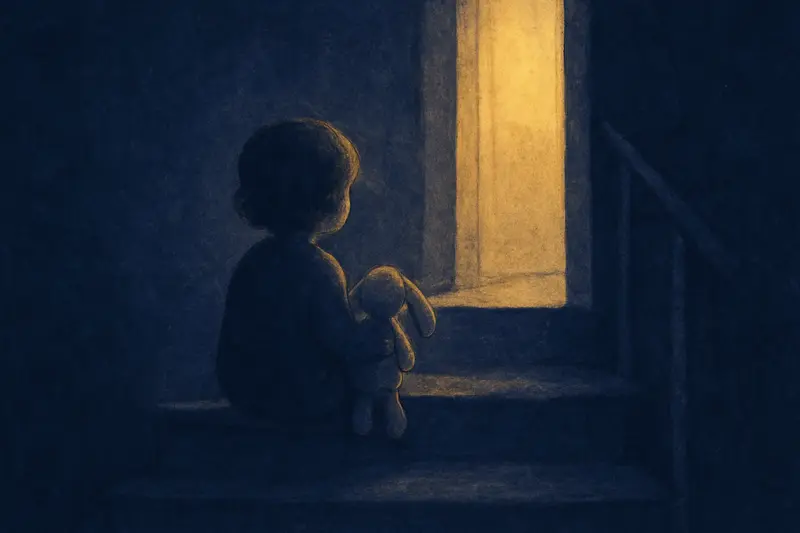
A child crying and you can't reach them. The books cited here have no crying child. Psychologists often read the child as a young, unprotected part of the dreamer, or a responsibility that feels too big. For parents it is usually simpler: the day's worry, carried into the night.
What does it mean to hear someone crying in a dream?
Crying from another room, never seen. Miller read hearing cries of distress as serious troubles from which an alert dreamer would finally emerge, even with gain; a wail heard mid-dream he read as fearful news. The modern ear hears something needing attention at the edge of awareness: sensed, not yet faced.
What does crying in a dream mean psychologically?
Psychologists hear crying in a dream as an emotional truth that waking hours have not yet allowed: tears arriving for a grief, a tenderness or a relief that has had no space in daily life. Freud treated feeling in dreams as the part of a dream least disguised.
The useful reframe is that the crying is rarely a problem to be solved. It tends to be the mind completing something left unfinished, which is why so many dreamers wake from these dreams oddly lighter. The dream did the crying you hadn't scheduled.
A question to sit with
If the tears in your dream knew exactly what they were for, what would they name? Answer fast, before the sensible part of you tidies it up.
Miller could say what tears meant in 1901. He couldn't say what yours are for, or notice that you cry in dreams before hard conversations, or only in your childhood house. Those patterns surface slowly, across many nights. Seeing them is what Dreamlock, on the App Store for iPhone, is built for: it listens to the dreams you record, paints them, and remembers which ones return.