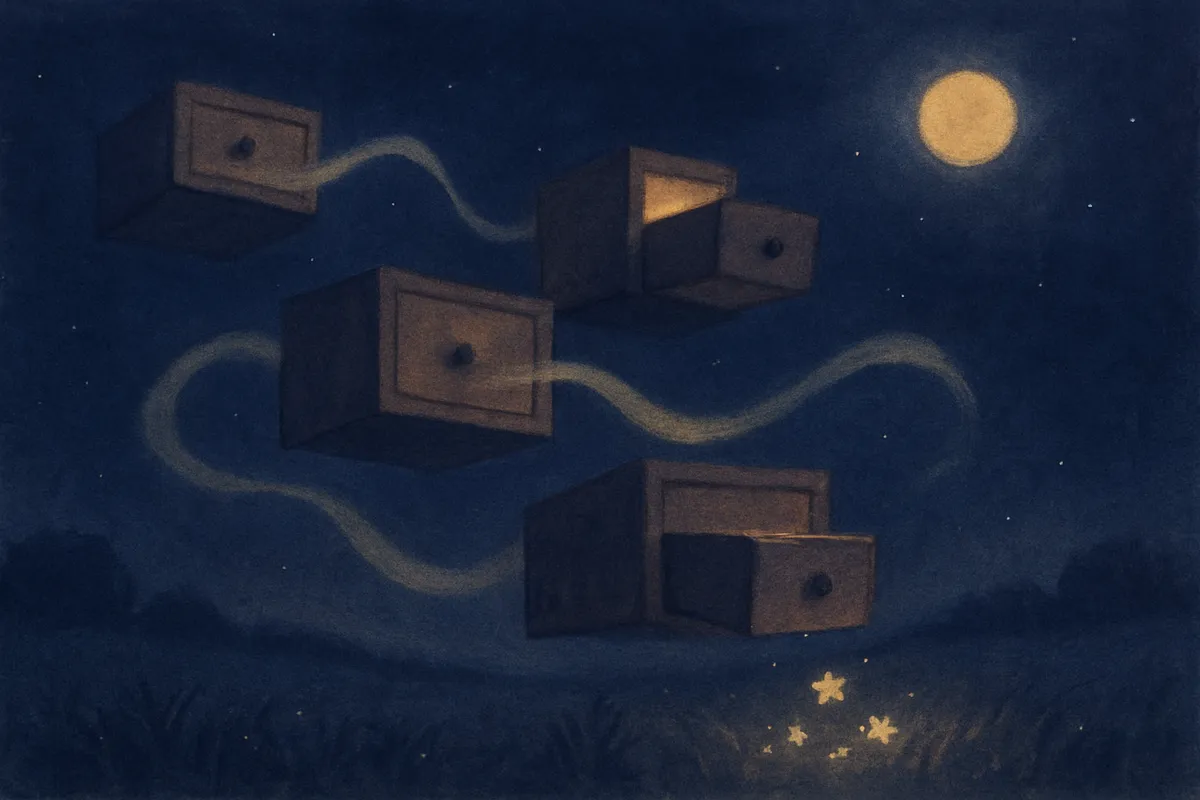
Here is the honest answer up front: nobody knows for certain why we dream. It is one of the oldest open questions about the mind, and anyone who tells you it's settled is selling something.
But "unsolved" is not the same as "unknown territory." Sleep researchers have spent decades watching what the sleeping brain does, and the serious theories that survive are few, elegant, and worth knowing. None has won outright — possibly because more than one of them is true.
The theater opens at night
Sleep is not one state but a cycle. Through the night you move between deeper, quieter stages and a remarkable one called REM sleep — rapid eye movement — in which the brain becomes nearly as active as when you're awake while the body lies deliberately still. Wake someone during REM and they will almost always report a dream, usually a vivid one. The other stages produce mental experience too, but thinner: a fragment, a worry turned over, a half-thought. REM is where dreaming becomes cinema.
So the raw fact is this: every night, several times a night, your brain runs elaborate simulations while carefully keeping you from acting them out. That's an expensive habit. The theories below are attempts to explain what the expense buys.
The serious contenders
Dreams as filing. One long-standing proposal is that sleep is when the day's experiences get sorted — kept, connected, or let go — and that dreams are what this sorting feels like from the inside. It fits something every student knows: sleep helps things stick. It also fits the collage-like texture of dreams, where yesterday's conversation stands in last decade's house. The night may be cross-referencing.
Dreams as emotional laundry. Another line of thinking holds that dreams help take the sting out of strong feelings — replaying what moved or frightened us, but in a state where the alarm is turned down, so the memory keeps its content and loses some of its charge. It would explain why dreams gravitate so reliably toward whatever we're anxious about, and why a hard day so often produces a crowded night.
Dreams as rehearsal. Some researchers have proposed that dreaming is an ancient training ground: a safe theater for practicing threats. It would explain one of the oddest facts about dream life — how much of it is unpleasant. Being chased, falling, arriving unprepared: if dreams were entertainment, they'd be terrible at it. As drills, they make a certain grim sense — you get to run from the danger without the danger.
Dreams as story-making. And there is a humbler school: perhaps the sleeping brain simply keeps generating activity, and the dreaming mind — a storyteller that cannot stop — weaves whatever surfaces into narrative. In this view the weaving itself may still matter, but the dream is less a message than a performance the mind gives for an audience of one.
Why the answer is probably "several"
These theories are usually presented as rivals. They read more like colleagues. Sorting memories, softening emotions, rehearsing threats, making stories — these aren't contradictory jobs, and a process as old and universal as dreaming has had a long time to pick up more than one.
What the contenders share is the interesting part: in every one of them, the dream is made of you. Your memories being filed, your feelings being laundered, your fears being drilled, your material being narrated. Dreaming also shifts with the state of the body that hosts it — run a high temperature and dreams turn darker and stranger, which is what a fever dream is. Whatever dreams are for, what they contain is not in dispute: the things that occupy you, wearing costumes.
The part that's up to you
Which suggests a practical conclusion to an unsolved question. You can't yet know why the theater runs every night — but you can start keeping the programs. A dream remembered is a note from the busiest, least guarded part of your mind, and dreams evaporate within minutes of waking, so remembering them is a skill worth learning. It's also why we built Dreamlock — coming soon — to catch the dream as a mumbled voice note before it fades, and have a card waiting by morning: the retelling, the symbols, a painting of what your night was working on.
Why do we dream? Ask again in a few decades. What did you dream? That one you can answer tomorrow morning — if something catches it in time.